
NHL Spreads and Puck Line Betting Strategy
 Available in US
Calculating Edge in NHL Puck Line Betting Markets
Across all NHL games in 2025, underdogs covered the +1.5 puck line in 60% of matches. That single number gets quoted constantly in betting circles, and most punters read it as a blanket instruction to back +1.5 dogs every night. I cannot count how many emails I’ve had from people telling me they’re “running the +1.5 system” and losing money. The 60% cover rate is real. So is the price you pay for it, which is exactly what neutralises the edge for anyone who treats it as a system rather than a starting filter.
This guide unpacks where the puck line actually pays — which spots magnify the underdog edge, when to lay -1.5 with a favourite, where alternate puck lines are worth a look, and how to think about live puck line moves once the game starts. After nine years of pricing this market for my own bets, I’d say the puck line is the single richest source of repeatable edge in hockey, and also the most efficient way to lose money quickly if you mistake the headline number for a strategy.
How the puck line actually works
The puck line in hockey is the goal-spread market, almost always set at ±1.5 goals. The favourite is listed at -1.5 and must win by two or more goals to cover. The underdog is listed at +1.5 and covers if they win outright or lose by exactly one goal. Because hockey games rarely finish at a margin of zero (overtime and the shootout decide ties), the standard puck line doesn’t push the way an NFL spread can — there’s always a winner and a loser of the bet.
A critical detail that newer UK punters miss: the puck line includes overtime and the shootout. If a game is tied after sixty minutes and decided in OT or a shootout, the winning team is credited with a one-goal margin — even though the actual goal came in the extra period or was simply the shootout-decider. That means a -1.5 favourite who wins in overtime does not cover. They’ve won by one goal in the official record, and the puck-line bet on -1.5 loses. Likewise, a +1.5 underdog who loses in overtime still covers, because they’ve only lost by one.

Empty-net goals matter too, and they matter more than most punters realise. A team trailing by one in the final two minutes will routinely pull their goalie, and the opposing side often scores into the empty net. That converts a one-goal game into a two-goal margin, which flips puck-line outcomes. The empty-netter is structurally a -1.5 cover assist and a +1.5 cover killer. Across a season, this effect alone moves several percentage points of cover rates on both sides.
One more piece of mechanics: the standard puck line is priced asymmetrically. A -150 home favourite on the moneyline often becomes +160 on the puck line at -1.5, while the +130 underdog moneyline becomes -190 on the +1.5 puck line. That price asymmetry is where the maths gets interesting, and where most of the confusion about “should I take +1.5 or the moneyline?” actually comes from.
The underdog cover data, properly unpacked
Back to that headline figure: 60% of NHL underdogs covered the +1.5 puck line across the 2025 sample. To make use of that number, you need to break it apart by situation, because the cover rate isn’t evenly distributed across the slate.
Home underdogs are the cleanest spot in the entire league. Home underdogs covered the spread 63.9% of the time in 2025, while home favourites covered only 41.8%. That gap — twenty-two percentage points — is the largest persistent asymmetry in NHL puck-line betting, and it’s been broadly stable for several seasons. The reason is structural. Home dogs play harder at home, hold leads better in their own building, and benefit from line-change advantages that the road favourite can’t fully neutralise. The 63.9% cover rate at home is the foundation that any +1.5 strategy should build on.

Now the price. Home dogs +1.5 are not priced at +100. They’re often priced at -180 to -220 depending on the underlying moneyline. At -200 on a +1.5 bet, your break-even cover rate is 66.7%. So even at 63.9% historical cover, you’re betting slightly below break-even on average, before accounting for closing-line value, situational filters, or vig efficiency. The headline cover rate is real but the price kills you if you blanket-bet.
Where the maths starts working is when you filter further. Home dogs against a road favourite on the second night of a back-to-back, where the road side played the night before, are a documented edge. In the 2023-24 NHL season, the rested team in any given matchup posted a 347-277 record with a +13.96 unit profit and a 2.2% ROI on the moneyline alone — and that’s just the rested-versus-tired split, before stacking it with the home-dog effect. Tampa Bay coach Jon Cooper put the fatigue reality plainly during one of the condensed-schedule seasons: Everybody’s tired — not just our team, all the teams.
The point isn’t that fatigue is rare; it’s that the books don’t price it evenly across the slate, and the home-dog spot is where the price gap is biggest. If a +1.5 home dog also happens to be the rested side, you’re stacking two effects that the closing line doesn’t fully absorb.
The other filter that meaningfully shifts cover rates is the goalie matchup. A confirmed elite starter in net for the home dog — top-ten in save percentage over the last ten starts — raises the +1.5 cover rate measurably. The number-one job before laying any puck line is confirming who’s actually playing. If you bet a +1.5 home dog without checking the starter and the backup is in, you’ve donated.
Road underdogs are a different story. The +1.5 cover rate for road dogs is closer to 56% across recent seasons, and they’re priced similarly to home dogs. That margin is much tighter, and blanket road +1.5 betting is essentially break-even with juice. Selective road +1.5 plays — divisional games, well-rested road side, elite starter — can still produce edge, but the systematic approach has to be home-dog first, road-dog only with strong filters.
Laying -1.5 with a favourite, and when it’s actually worth it
Laying -1.5 is the inverse problem. The cover rate for home favourites at -1.5 was 41.8% in 2025. Road favourites at -1.5 cover slightly higher, around 44%, because the road favourite who wins is more likely to be the materially better team and therefore more likely to win by multiple goals. Either way, you’re betting on a sub-50% outcome and getting paid plus-money for the trouble.

At a price of +160 to +180, a -1.5 bet needs a cover rate north of about 36% to break even. So at 41.8% cover for home favourites, you’re already above water on average — but again, the average is doing all the work and the average doesn’t pay. The spots where -1.5 actually generates positive EV are narrow and specific.
The strongest -1.5 spot I track is the heavy moneyline favourite at -200 or shorter with a confirmed elite starter against a road dog on the second night of a back-to-back. The moneyline price tells you the market thinks the favourite wins about 67% of the time. The puck line offers you a multi-goal win at +160. The question is whether the conditional probability of a multi-goal win, given that the favourite wins at all, is high enough to make the puck line better than the moneyline in EV terms. With a tired road dog and a dominant home club, it often is — and the data backs it up over multi-season samples.
The trap I see UK punters fall into is laying -1.5 on home favourites priced at -120 to -140. The moneyline implies roughly a 55% to 58% win rate. The conditional probability of a multi-goal win given a win is generally around 60%, which means the unconditional probability of a -1.5 cover is in the 33% to 35% range. At +160 to +180 on the puck line, that’s roughly break-even with juice. You’re not finding edge there; you’re paying tax to feel clever about plus-money.
The rule I follow: never lay -1.5 on a favourite priced shorter than +150 unless the moneyline is at least -180, and only then if the starter is confirmed and the matchup is structurally lopsided. If you can’t articulate why this specific game is more lopsided than the price implies, pass.
Alternate puck lines and the juice trade-offs
Most UK books now offer alternate puck lines — ±2.5, ±2, ±1, and occasionally ±3 — at adjusted prices. These aren’t gimmicks. They can be useful tools when you have a strong opinion that doesn’t fit the standard ±1.5 spread.
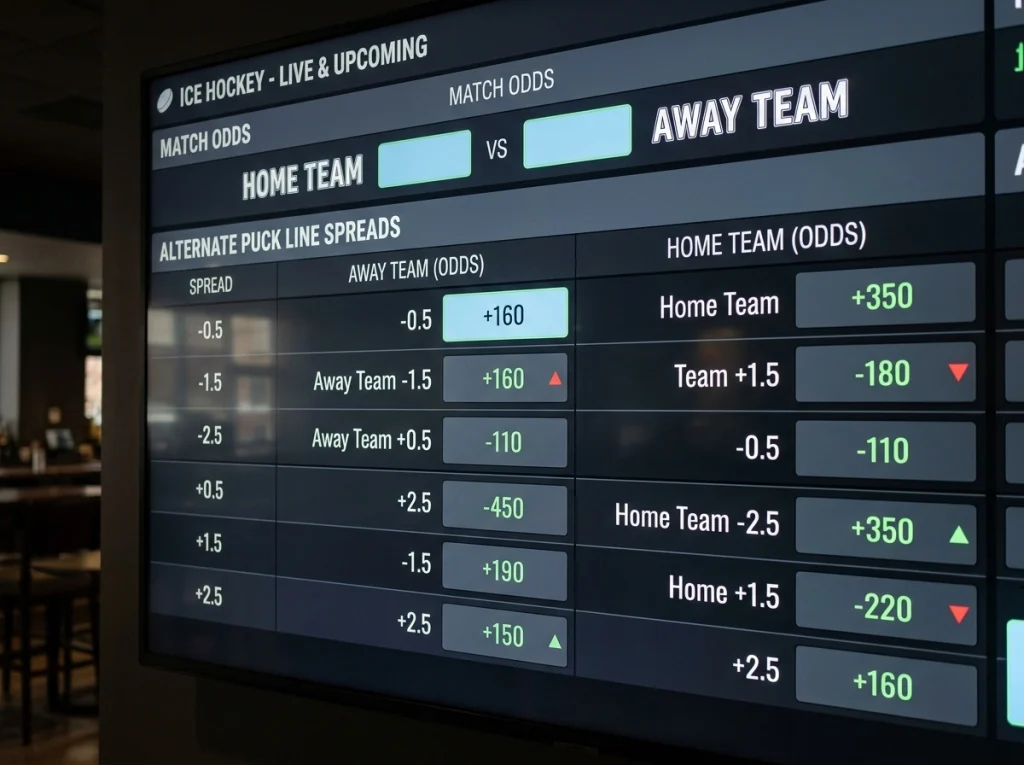
The most useful alternate, in my experience, is +2.5 on a road dog you genuinely like but don’t think will win outright. At +2.5, the dog can lose by two goals and still cover, which means an empty-net goal in the dying seconds doesn’t kill the bet. The price you pay is heavy juice — often -350 to -450 — but in spots where you’d rather have insurance against a late empty-netter, +2.5 can be the right choice over +1.5. Specifically: a road dog with a strong goalie facing a top-tier home favourite where the third-period scenario looks like the home club coasting in regulation. The empty-net goal is the realistic worry, not the two-goal blowout. +2.5 hedges precisely that.
On the favourite side, -2.5 is the alternate for when you think the matchup is genuinely a blowout but the standard -1.5 price doesn’t reward you enough. -2.5 at +250 to +300 is a high-variance bet, but if you’ve narrowed down to a small number of spots per season where the talent and form gap is real, it’s a market worth using. I bet -2.5 maybe four or five times across an 82-game season for any single team. It’s not a regular play.
-1 and +1 alternates are odd ducks. -1 on the favourite at heavy juice (often -150 to -200) effectively turns the puck line into a moneyline with a small extra hurdle — the favourite must win by at least one goal in regulation. That’s basically the moneyline minus overtime variance. If you think the favourite has a strong third-period push and isn’t likely to need OT, -1 can be marginally better EV than the standard moneyline. Marginal, though. I rarely use it.
Puck line versus moneyline — the EV calculation that decides the bet
The most useful mental model I’ve found for puck-line decisions is to think of every puck-line bet as a substitute for a moneyline bet, and to ask which version of the same opinion gives better EV.

Take a concrete example. Home favourite priced at -150 on the moneyline, -1.5 on the puck line at +165. That moneyline implies a win probability of 60%. The puck-line price of +165 implies a probability of 37.7% that the favourite wins by two or more. If your model puts the conditional probability of a multi-goal win at 65% (i.e., when the favourite wins, they win by 2+ about 65% of the time), then the unconditional 2+ probability is 0.60 × 0.65 = 39%. At +165, you need a 37.7% true probability to break even. You have 39%. Edge is 1.3 percentage points, or roughly 3.4% ROI on that bet.
Now run the same model on the moneyline. At -150 with a 60% true probability, your EV is positive by 2 percentage points, or 3.3% ROI. The two bets are essentially equivalent — the puck line is fractionally better, but within the margin of model error. In that case, take the moneyline because the variance is lower.
The puck line decisively beats the moneyline only when the conditional probability of a multi-goal win, given a win, is higher than the moneyline market is implicitly pricing. That happens in lopsided talent matchups and in tired-versus-rested matchups, and it’s the EV reason home dogs +1.5 tend to be the better play than home dogs on the moneyline.
I keep a spreadsheet of historical conditional-margin probabilities by matchup type. If you do nothing else with the puck line, do this: track, for every bet, whether the moneyline would have produced better EV. After 100 bets you’ll have a clear picture of which spots actually favour the puck line and which spots you should have just been on the moneyline. Mine took about two seasons to populate properly, and it changed how I bet roughly a third of my hockey card.
Live puck lines and how they move
Live puck-line markets are a different animal. The line resets after every goal, often with new juice attached, and the speed at which it moves in the third period is one of the more interesting tactical environments in hockey betting.
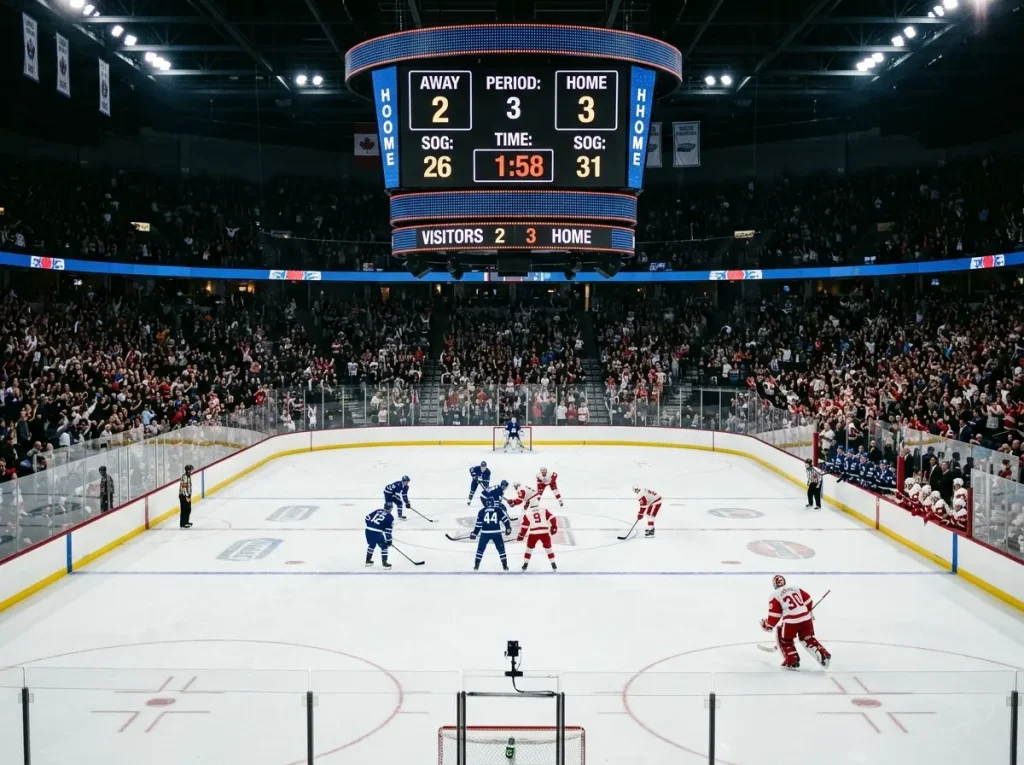
The most common live spot I look at is the +1.5 puck line on a road favourite that goes down 1-0 early. The moneyline blows out, the puck line shifts to something like +1.5 at -120 from a pre-game -180. If the road favourite is genuinely the better team and you have a thesis that the deficit is variance not structure, the live +1.5 at reduced juice can be the spot to enter the position you didn’t enter pre-game. The model is simple: the team’s underlying win-and-cover probability hasn’t changed dramatically because of one bad bounce, but the live market has reacted to the scoreboard rather than the underlying.
The third-period puck line is where the empty-net effect becomes everything. A one-goal game in the third with the trailing team’s goalie about to come out skews the live puck line in a very specific way. The favourite who’s leading sees their -1.5 odds drop because the empty-netter is the realistic path to cover. The dog who’s trailing sees their +1.5 odds lengthen for the same reason. If you understand the goalie-pull mechanics — and we have a deeper piece on how empty-net moments shape late-game betting — you can identify spots where the live line is overreacting to the threat of the empty-netter or underreacting to a club that doesn’t tend to score them.
One word of caution. Live puck-line markets at UK books are sometimes suspended during scoring chances, faceoffs in the offensive zone and after delayed penalties. If your strategy depends on a specific entry price, you’ll miss it more often than you catch it. Treat live puck-line betting as opportunistic, not as a fixed plan.
Does the puck line include overtime and shootout?
Yes. The standard puck line in hockey settles on the final score, including any overtime and shootout. A team that wins in OT or a shootout is credited with a one-goal margin for puck-line purposes, regardless of which period the deciding goal came in. That means a -1.5 favourite who wins in OT does not cover, and a +1.5 underdog who loses in OT still covers.
Why is the +1.5 puck line not always +EV despite a 60% cover rate?
Because the price you pay for +1.5 is the cost of insurance against a multi-goal loss, and that insurance is priced into the line. A 60% historical cover rate at -200 juice means a break-even rate of 66.7% — so on average, blanket +1.5 betting is slightly below break-even before situational filters. The edge appears when you stack filters like home dogs, rested teams, confirmed elite starters, and divisional matchups that push the cover rate above the break-even point.
What is an alternate puck line at UK sportsbooks?
An alternate puck line is any spread other than the standard ±1.5. UK books typically offer ±2.5, ±2, ±1, and occasionally ±3 with adjusted prices. +2.5 on the underdog provides insurance against a late empty-net goal but at heavy juice; -2.5 on the favourite pays plus-money but requires a genuine multi-goal blowout. They"re tools for specific situations, not standard bets.
When should I prefer -1.5 to a heavy moneyline favourite?
When the moneyline price is at least -180 and you have specific reasons to expect a multi-goal win rather than a narrow one — a tired road opponent on a back-to-back, a confirmed elite starter for the favourite, a divisional matchup where the favourite has historically dominated, or a clear talent gap in special-teams matchups. Below -180 on the moneyline, the conditional probability of a multi-goal win is rarely high enough to justify the puck line over the straight win bet.
Articles
Prepared by the Ice Hockey Betting Tips editorial staff.
