
Elite League Predictions and EIHL Betting Tips
 Available in US
Elite League Betting Value and UK Hockey Market Depth
I spent a Saturday night in February 2024 at the SSE Arena in Belfast watching the Giants pull away from Sheffield in the third period. Around me, the rink was sold out — 8,500 seats, full, every match-night, mid-season — and a thought I’d had for years finally crystallised: this is the most under-bet major league in British sport. The 2025-26 EIHL season set an all-time attendance record of 1,321,128 spectators across the campaign, averaging 3,863 a game, the fourth consecutive year of growth. Try finding that level of organic momentum in any other UK sport that isn’t football, cricket, or rugby. You can’t.
Now compare that to how the books treat it. Lines on the EIHL go up later than NHL lines, move less in response to news, and stay loose on player-specific markets. The volume isn’t there for the books to invest in tight pricing. For a UK punter who actually pays attention to the Elite League — who knows what Belfast’s third line looks like in November, who can name Cardiff’s first-pairing defencemen, who has seen Sheffield play live — that gap is real money. This is the league where my edge has been highest, every season, for nine years.
What the Elite League actually is, and why structure matters for your bets
The EIHL ran ten clubs in 2025-26 with 270 regular-season matches across the campaign. Each club plays a long, balanced schedule — far more than the casual viewer realises — and the season splits into the Challenge Cup (group stage and knockout), the Aladdin Cup (which has rotated formats), the regular Championship, and the playoff knockouts in April. Four distinct trophies, which means four distinct outright markets, plus the dense weekly schedule of league matches.
Belfast Giants ran away with the regular-season title in 2025-26, finishing on 84 points with a +85 goal differential (207 goals for, 122 against). They’ve been the regular-season benchmark for the better part of a decade. The playoff title, though, went to Cardiff Devils, who beat Sheffield Steelers 5-2 in the final to claim their fourth playoff crown. The split between regular-season dominance and playoff variance is one of the most punter-relevant facts about this league — and books regularly fail to reprice playoff outrights aggressively enough when April rolls around.

The clubs themselves break into rough tiers based on budget, recruitment depth, and venue. Belfast, Sheffield and Cardiff sit at the top in any given season. Nottingham Panthers and Coventry Blaze move between mid-table and contention depending on the year’s imports. The remaining clubs — Manchester Storm, Glasgow Clan, Dundee Stars, Fife Flyers, Guildford Flames — fight for the bottom half of the table and the eighth playoff spot. Half the league averages over 3,000 fans per match. The other half doesn’t, and that gap shows up in budget, which shows up on the ice.
For an outright bet, the league rewards homework on import recruitment in late August and September. EIHL rosters turn over substantially every summer — most clubs sign new imports in July and August — and the bookmakers’ opening prices in late September lean heavily on the previous season’s finishing order. That lag is your friend if you’ve actually paid attention to who signed where.
The top clubs, the recruitment cycle, and what to read into form
Belfast Giants are coached by Adam Keefe, who took over a decade ago and has built what he himself called the culture and identity we’ve built here in Belfast
when he was confirmed for another season. The Giants’ edge isn’t a single star — it’s roster stability, an arena that genuinely shifts games in the third period, and a recruitment philosophy that prioritises low-mistake hockey. Their captain David Goodwin returned for the 2025-26 campaign with a four-man leadership group that gave the dressing room an unusual continuity.

Sheffield Steelers under Aaron Fox have positioned themselves as the consistent challenger. Fox, asked about the 2025-26 title race, gave one of the more honest assessments I’ve heard from a coach: Obviously you’re never going to look past what Belfast has done. They are the benchmark right now again — they won two of the three trophies last year and before we won the treble they were right there as well winning three trophies the year before us.
That sort of public deference is unusual in the EIHL and it tells you something about how Sheffield are setting themselves up — as a team that knows the gap exists and is targeting it specifically.
Cardiff Devils sit in their own category as a playoff team rather than a regular-season team. Four playoff titles to their name, including the 2025-26 crown, while only sporadically finishing top of the table. If you’re betting the playoff outright in March, Cardiff’s record demands a longer look than their seeding might suggest, especially if they enter the playoffs with a healthy roster and an in-form starter.
What I actively don’t do is rely on the last five games as a form signal in the EIHL. The schedule is uneven — clubs play different opponents in different stretches — and a 3-1-1 run against the bottom half doesn’t mean what it would mean in the NHL. I look at goal differential per game over the last fifteen, special-teams numbers split between home and away, and which imports are actually producing versus which were signed on hype. The hype-signing failure rate in the EIHL is meaningful, and it’s a market everyone overweights at the start of the season.
EIHL market depth versus the NHL — what’s actually available
The single biggest practical difference between betting the EIHL and betting the NHL is market depth. An NHL game on a Wednesday night at a major UK book will have a moneyline, puck line, total, alternate puck lines, alternate totals, team totals, period markets, first-team-to-score, anytime scorer, shots on goal props, and often more. The same book might offer an EIHL game on the same Wednesday with just the moneyline, puck line, total, and possibly a first-period winner.
That sounds like a disadvantage, and on the surface it is — fewer markets means fewer angles. But there’s a flip side that most punters miss. Thin markets are loose markets. The book is allocating fewer resources to pricing the EIHL because the handle doesn’t justify a dedicated trader on every game. The lines they put up are derived from a model with limited Elite League-specific calibration, and they’re slower to react to news because the news flow itself is thinner. If you have actual EIHL knowledge — and you can, because the league is small and the information is in fan podcasts and local press — you’re competing against a model, not against a sharp trader.
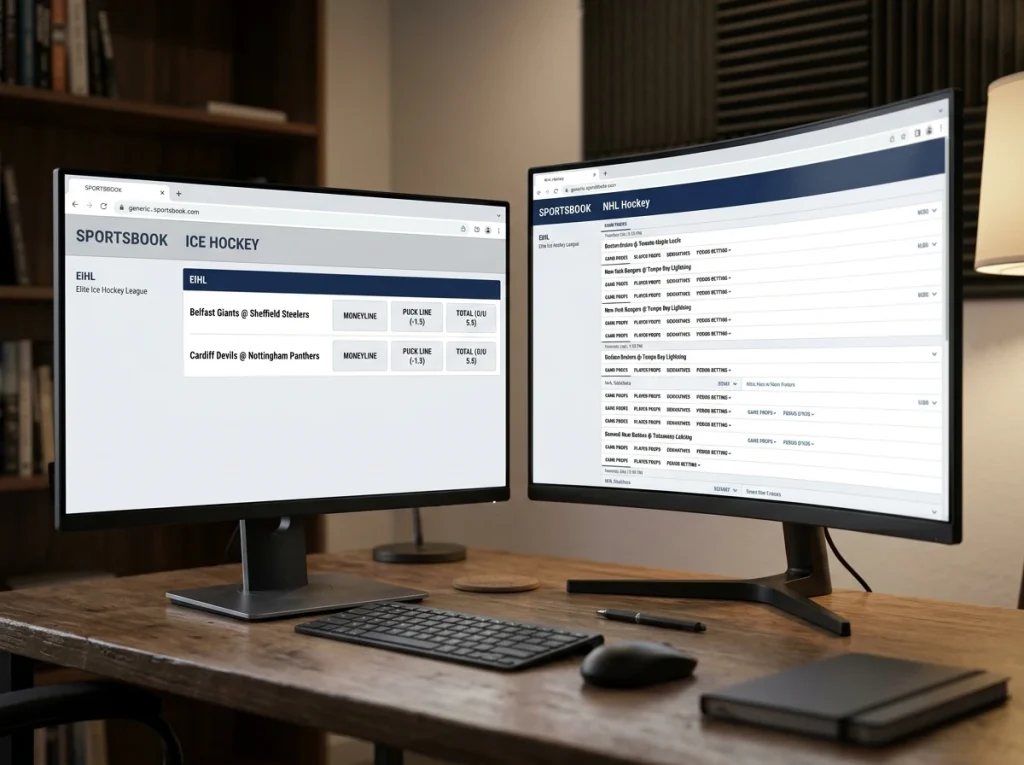
Minimum stake sizes at UK books on the EIHL are typically generous (often £1 or less) and maximum stake sizes are lower than on the NHL. I’ve personally been capped on EIHL moneyline bets at £200 to £300 by major UK operators that would happily take £2,000 on the same number of pounds of perceived edge in the NFL. That’s annoying but informative — when a book limits you on EIHL specifically, it’s effectively acknowledging that you know something they don’t.
Live betting on the EIHL is patchy. Some operators offer in-play markets, some don’t, and the ones that do typically suspend the market during scrambles, faceoffs in the defensive zone, and any moment of uncertainty. If live EIHL betting is your model, the books that offer it will become a small, frustrating list.
Home advantage in UK rinks is different — and it’s stronger
NHL home ice advantage is real but well-priced. EIHL home ice advantage is real and frequently underpriced, for reasons connected to the venues themselves. NHL arenas are 17,000 to 22,000 seats, mostly corporate, often emotionally muted outside of playoff hockey. EIHL arenas are 3,000 to 8,500 seats, vocal, partisan, and physically close to the ice in a way that genuinely affects play.

I’ve watched a Belfast Giants third period at the SSE Arena where the crowd was so loud the visiting goalie visibly flinched on a routine point shot. That doesn’t happen in Calgary in November. It happens in Belfast in November, regularly. The effect on referee calls, neutral-zone aggression and faceoff focus is measurable across the league.
The smaller venues also tilt the goal-scoring environment. EIHL rinks vary in ice dimensions, and several are noticeably tighter than NHL standard. Tighter ice means more cycle play in the offensive zone, more rebound chances, and historically higher per-game scoring volatility — which is why EIHL totals are often more profitable to bet on the over when both clubs are running healthy first lines, and far more profitable to bet under when a club is dressing a thin defensive corps due to injury.
The practical edge: when you’re handicapping an EIHL home game, weight the venue itself harder than you would in the NHL. A road-favourite price that would look reasonable in a 19,000-seat NHL arena often looks short in an 8,000-seat Belfast arena where the home club is on home ice for the third time that week. The market underprices that effect more often than not.
Cups, playoffs and the outright markets worth betting
The EIHL trophy structure is a punter’s playground if you understand what you’re actually betting on. Four distinct competitions, four distinct outright markets, and each runs on its own schedule and its own logic.
The Challenge Cup is the early-season group-and-knockout competition. Clubs are grouped, play home-and-away, top sides go through to the quarter-finals. The market on this opens earlier than most punters expect — sometimes in late September — and the opening prices lean heavily on the previous season’s results. If a club has overhauled its top six forwards and signed a top-tier import goalie, the September Cup price is often stale by November. I’ve cashed Challenge Cup outrights three times since 2020 on bets placed in October that looked unremarkable at the time.

The Championship outright — the regular-season league title — is the long-haul market. Belfast have been priced as the favourite three years running for good reason. The question for outright bettors is whether the price you’re getting reflects their actual win probability or whether the market has them too short. In 2025-26 they finished on 84 points with that +85 differential, and the price reflected the dominance pretty cleanly. The value in this market tends to live in the each-way side — second-place finishes at the right price.
The Playoff Championship is the most volatile and the most under-priced. Eight teams qualify, the format compresses results, and a single hot goalie can carry a fourth-seed to the final. Cardiff are the historical proof of that — they win playoff titles disproportionately to their regular-season finishes. If you back a playoff outright on a club that’s entering with a healthy roster and a confirmed elite starter, you’re often getting odds that don’t reflect the actual variance in the format.
The Aladdin Cup is the smallest of the four. Lower volume, looser pricing, and worth a look if a club’s schedule is structured such that they’re getting an unusually favourable draw.
Hedging strategy matters more in EIHL outrights than in NHL futures because the field is smaller. If you’ve backed Belfast at the start of the season at 6/4 to win the Championship and they’re sitting top of the table by 12 points in February, the price might shorten to 1/4. A small hedge on the field — specifically on Sheffield or Cardiff — at that point locks in a meaningful return regardless of the final standings. The maths of a ten-team league makes hedging clean in a way that a 32-team NHL doesn’t.
The mid-week scheduling quirk that creates value
One scheduling feature of the EIHL barely anyone talks about is the Wednesday-Saturday-Sunday rhythm that most clubs run. Wednesdays are often one-off matches, Saturdays are headline match-nights, and Sundays are the second leg of weekend doubleheaders. The fatigue profile across those three days is meaningfully different from the NHL’s back-to-back-or-bust calendar.

A club playing Saturday-Sunday in the EIHL is genuinely tired by the Sunday third period. The travel distances in British hockey are short by NHL standards, but the dressing-room recovery time between a Saturday night home game and a Sunday afternoon road game is brutal. I’ve tracked Sunday second-leg performance for years and the under on Sunday afternoons skews more profitable than almost any other situational angle in the league, especially when both clubs played hard on the Saturday.
That doesn’t translate into blanket under-betting every Sunday. The signal sharpens when the road club on Sunday was on the road on Saturday as well, when their starter went the full sixty on Saturday, and when the Sunday opponent has a strong home penalty kill. Stack those filters and you’ve found one of the cleaner repeatable angles in UK domestic hockey.
The flip side — Saturday nights at top venues — skews the other way. Big crowd, fresh legs, the marquee starter in net, the club running its full first line ten minutes per period. Saturday-night EIHL totals at the top venues consistently overshoot the closing total, and the over has been a genuinely positive-EV bet across multi-season samples when both starters are confirmed and both clubs have full rosters.
Line shopping is more important here than anywhere else in UK betting
I have accounts at five UK books and I check three of them before every EIHL bet. That’s not paranoia, that’s economics. The dispersion of EIHL prices across UK books is genuinely wider than for almost any other regularly-bet UK sport.

On a typical Friday EIHL slate, you might find a Belfast home moneyline at 4/9 (1.44) at one book, 2/5 (1.40) at another, and 4/11 (1.36) at a third. Those are real, regular gaps. Across a season of betting moneylines on the favourite side, that price spread compounds into the difference between a 1% ROI year and a 5% ROI year. Decimal odds make the gaps easier to see — I switched all my UK accounts to decimal display in 2019 and my line-shopping speed roughly doubled.
The dispersion is even wider on totals and on alternate puck lines. EIHL alternate markets exist sporadically at some books and not at all at others. If your strategy involves alternate lines, your account base needs to include the books that actually offer them, which narrows the field considerably.
A practical workflow: open three tabs every match-night, paste the slate, write down the best available price for each market you’re considering, and only bet when one book is clearly out of step with the others. The discipline is in not betting at the second-best price when the best is sitting in another tab. The 3% to 5% edge you’re chasing in this league lives in those margins, and the punters who shop lines consistently are the ones I see still betting the EIHL five years later. The rest move on to IIHF World Championship outrights in May and wonder why their year-end totals look the way they do.
How does EIHL betting differ from SHL or DEL betting?
Market depth is the biggest difference. The Swedish SHL and German DEL get significantly more attention from European books and sharp money, so the lines are tighter and move more aggressively on news. The EIHL gets less of that, which means looser pricing, slower line moves, and more opportunities for a punter with genuine UK-specific knowledge. The trade-off is that prop and live markets in the SHL and DEL are deeper than in the EIHL across most UK books.
Which EIHL clubs have the strongest home record in 2025-26?
Belfast Giants were comfortably the strongest home club in the regular season, on their way to 84 points and a +85 goal differential. Sheffield Steelers and Cardiff Devils both posted strong home records, and Cardiff used theirs as the springboard to the playoff title. As a general rule, the top three clubs separate themselves at home more than they do on the road, which is exactly where you"d expect to find the most profitable home-favourite edges across a season.
Can I bet on EIHL Challenge Cup and Championship as separate outrights?
Yes, the major UK books treat the Challenge Cup, the regular-season Championship, and the Playoff Championship as separate outright markets with separate prices. The Challenge Cup opens earliest, usually in late September, and tends to have the loosest opening prices because the books lean heavily on the previous season"s results before the imports have shown what they"re capable of.
Are EIHL props widely available at UK books?
Player props on the EIHL are thin compared to the NHL. Some major UK books offer anytime scorer markets on bigger matches — Belfast versus Sheffield, playoff games — but coverage drops sharply for the weekday slate. Shots on goal props are rare. If prop betting is a meaningful part of your strategy, the EIHL won"t sustain that volume; the value in this league lives in the headline markets and the outrights.
Articles
Published by the Ice Hockey Betting Tips team.
