
Late-Game Markets and NHL Empty-Net Betting
 Available in US
Pulled-Goalie Scenarios and Empty-Net Betting Markets
I have watched roughly two thousand NHL games end with an empty-net goal swinging an over total over the line. The pattern is one of the most reliable in hockey betting and one of the most consistently underpriced by recreational bettors. The trailing team pulls its goaltender with around 1:30 to 2:00 remaining in the third period. The chasing team commits six skaters to the offensive zone. The pucks come out of the defensive end, find centre ice, and a quarter of them end up in an unguarded net. The total ticks over by one goal. The over cashes. The under does not.
This is the article on how to bet, and how not to bet, those last three minutes.
How often the empty net actually scores
An empty-net goal is scored in roughly 18 to 22 % of NHL games — the rate has crept up over the last decade as coaches pull goaltenders earlier and more aggressively. The headline frequency hides a more useful conditional: empty-net goals are concentrated in games where the trailing team is exactly one goal behind in the final three minutes, which is the condition under which the goaltender is most likely to be pulled.
In games that arrive at the final three minutes with a one-goal margin, the probability of an empty-net goal climbs to roughly 35 %. In games with a two-goal margin entering the final three minutes — the situation where goaltenders are pulled earlier and more aggressively — the empty-net rate rises further still, into the 40 % range. The total goals market does not always price this condition explicitly, but the live total moves dramatically when the score sits at one or two goals’ margin in the final five minutes.
For the static pre-game total, the empty-net adjustment is small but real. A pre-game total of 6.0 should arguably be priced closer to 6.1 to fully account for the empty-net distribution. Most books price tighter than that. The cumulative under-pricing of empty-net contributions is one of the reasons over bets on tight pre-game totals — particularly the 5.5 — carry a small structural edge.
The save percentage context that frames everything
League-wide save percentage in 2024-25 was .901 — a nineteen-year low. Peak save percentage was .915 in 2014-15. The drop of fourteen basis points over a decade represents a fundamental shift in the run environment of NHL hockey. Goals are easier to score now than they were ten years ago, and the relative weight of empty-net goals in the total has shrunk slightly because the underlying scoring rate has risen.

Andrei Vasilevskiy framed the change cleanly: “I feel that players don’t waste shots anymore. When I came into the league in 2014-15, it used to be 30 or 35 plus shots every game. It was almost every night you felt good about your performance because you were in the game all the time. Today, players don’t waste shots. It’s about quality.” The implication is that the modern NHL produces more high-quality scoring chances per shot, which means goaltenders concede more goals on similar shot volumes than they did a decade ago.
For the late-game betting question, this matters because the marginal empty-net goal still adds the same absolute amount to the total — but the rest of the game produces more goals than it did, so the percentage contribution of the empty-net goal to over totals is smaller. The net effect is that over bets remain reasonable, but the empty-net angle alone is not enough to drive them.
When pulling the goalie actually helps
The decision to pull the goaltender is, in expected-value terms, almost always correct for the trailing team. Modern analytics suggests pulling at around three minutes remaining when down by one, and as early as four to five minutes when down by two. The expected goals against rises sharply with six skaters and an empty net, but the expected goals for rises by enough to make the trade-off positive in win probability.

For the bettor, this means the leading team is more likely than the casual viewer expects to add a goal in the closing minutes — and the trailing team is also more likely than the casual viewer expects to score the tying goal. The variance in the final three minutes is much higher than in the average three-minute stretch of regulation. That variance creates several distinct betting opportunities.
The clearest is live over betting in a one-goal game with under two minutes remaining. The implied probability of the over hitting is typically priced at the start of that window as if the empty-net contribution were negligible. It is not. Backing the over at +200 or longer in that window — when the game total is one goal short of the line — has been a recurring positive-expectation angle in my tracking for years.
The other side: live under betting in close games
The mirror image of the empty-net over bet is the live under bet in two-goal games where the trailing team has not yet pulled its goaltender. If you are watching a game that sits at, say, 4-2 with five minutes remaining and the trailing team is still skating with its goaltender in net, the under has unusual value — the conditional probability of an empty-net goal is much lower because the goaltender has not yet been pulled and may not be.
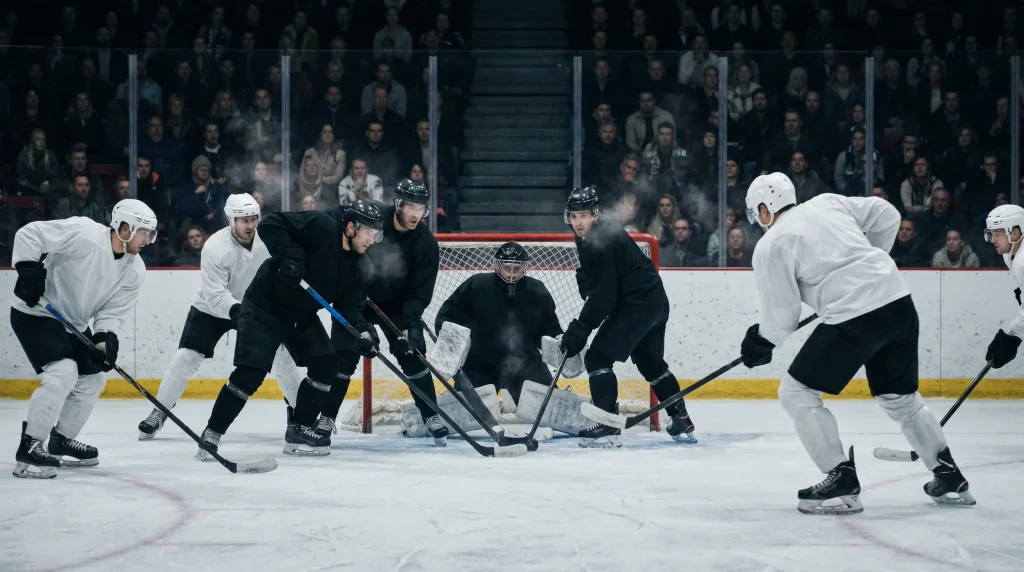
The pattern shows up most often in games where the trailing team is on the second night of a back-to-back, a fatigue context where coaches sometimes accept the loss and protect their players rather than empty-net for the tying push. The fatigue effect compounds — second-night-of-back-to-back teams are already underperforming, and the late-game pulled-goalie behaviour is suppressed further. The under in those games carries a small but persistent edge.
Anytime scorer and the empty-net dynamic
The empty-net dynamic also affects anytime-scorer bets. The empty-net goal itself is almost always scored by a forward, and disproportionately by the wing or centre playing on the top defensive line for the leading team. A reliable secondary-scorer prop pattern is that defensive-minded forwards on contending teams — the bottom-six grinders who get the late-game defensive zone draws — score empty-net goals at a rate roughly three times higher than their season scoring profile would suggest.

The prop market does not always price this. A bottom-six forward at +400 anytime scorer is being priced on his season scoring rate, not on his empty-net opportunity. If the matchup looks like one where the leading team will be defending a late lead — strong defensive matchup, road game in a hostile building, second-night-of-back-to-back for the favoured team — the bottom-six forward is a quietly attractive prop. The hit rate is low. The price compensates.
The total adjustment in your model
If you run any kind of total-goals model for NHL bets, the empty-net adjustment should be explicit rather than buried inside a general scoring rate. The cleanest way I have found to handle it: forecast a base scoring rate from the matchup’s expected goals, the goaltender quality, and the pace; then add an empty-net contribution of roughly 0.18 goals to the expected total, weighted by the conditional probability of arriving at the final three minutes with a one-goal margin.

The conditional probability of a one-goal margin in the final three minutes is approximately 30 % across NHL games, with higher probability for close pre-game lines and lower probability for blowout pre-game lines. Multiplying through, the empty-net contribution to expected total goals is roughly 0.05 to 0.07 in a typical game — small in absolute terms but enough to swing the bet on a 5.5 / -110 vs 5.5 / +110 sort of price comparison.
The bettor who builds this in explicitly will, over a long season, capture the small recurring edge that the empty-net dynamic creates. The bettor who buries it inside a general model will not.
The shape of the late-game edge
The empty-net opportunity is the single most consistent late-game pattern in NHL betting, but it is not large. Treat it as a recurring half-percentage-point edge on the right side of the right markets, applied across enough volume to matter. Live overs in one-goal games inside the final two minutes. Live unders in two-goal games where the goaltender has not yet been pulled. Anytime-scorer props on bottom-six forwards in defensive-matchup spots. Total-goals adjustments in your model that price the empty-net contribution explicitly.

None of these is a “lock”. All of them, sized correctly and bet consistently across a season, contribute meaningfully to the overall portfolio expected value. The late three minutes of an NHL game are where a meaningful share of the total-goals action actually happens. Most bettors price them as if they were the same as any other three minutes. They are not. That is the edge.
For the broader context on how goaltending shapes the markets these late-game patterns sit inside, the starting goalie impact on NHL odds piece is the natural companion.
How often does an empty-net goal occur in an NHL game?
Roughly 18 to 22 % of NHL games end with at least one empty-net goal. The rate is much higher conditional on the game arriving at the final three minutes with a one-goal margin, where empty-net rates climb to around 35 %. In two-goal-margin games where the goaltender is pulled earlier, the empty-net rate can reach 40 %.
Should I bet live overs in close NHL games?
Live overs in one-goal games inside the final two minutes, where the trailing team has pulled or is about to pull its goaltender, are one of the more consistent positive-expectation angles in NHL betting. The book typically prices the over too long because the empty-net contribution is hard to fully account for in real time. The hit rate is in the 35 to 40 % range and prices of +200 or longer make it worthwhile.
Does pulling the goaltender always help the trailing team?
In expected-value terms, almost always. Modern analytics suggests pulling at around three minutes remaining when down by one and as early as four to five minutes when down by two. The expected goals against rises with six skaters and an empty net, but the expected goals for rises by more, making the trade-off positive in win probability. The coach who pulls late is often leaving win probability on the table.
Articles
Published by the Ice Hockey Betting Tips team.
