
 Available in US
The data UK punters never get from a single sportsbook page.
Data-Driven Ice Hockey Betting Tips for UK Punters
Nine years into modelling hockey lines, I still mark up the same lesson at the top of my notebook every October: the gap between a confirmed starting goaltender and a rumoured one is worth roughly three to five per cent of implied probability. That is not a slogan. That is the working number a head of hockey at a major sportsbook quoted to ESPN, and it is the kind of figure the top ten Google results for "ice hockey betting tips" still refuse to put on the page.
This guide is the one I wish a UK punter handed me when I first walked from football accumulators into a Stanley Cup playoff series. It is built for the British bookmaker landscape, with UKGC compliance baked in, prices read in fractional and decimal, and a hard focus on the markets that actually move money: the moneyline, the puck line, totals, and the three-way regulation line that British books quietly push.
Scope: I cover NHL, the Elite Ice Hockey League at home, and the European competitions that show up on UK-licensed shelves — Champions Hockey League and IIHF events. Everything here assumes you bet at a UKGC-licensed operator. Offshore sites are out of scope because they are out of your legal protection.
What you will not find here is a list of "best bookmakers" with affiliate badges, or a recycled glossary cribbed from a US site. What you will find is the data the casual guides skip — home/road splits, back-to-back ROI, save percentage drift, integrity figures — woven into a workflow you can run in fifteen minutes before puck drop.
Slapline Ice Hockey Betting Edge and UK Market Analytics
- Home favourites won 64.1% of NHL games in 2024-25, but home underdogs covered the puck line 63.9% of the time — the value lives in the underdog spread, not the chalk.
- NHL save percentage has slid to .901, a nineteen-year low, which structurally pushes totals higher and rewards over bettors who read pace correctly.
- A confirmed starting goaltender shifts implied probability by three to five per cent — wait for the lineup before pulling the trigger on a moneyline.
- The EIHL drew 1.32 million spectators in 2025-26, a fourth straight attendance record, which means deeper, more honestly priced UK domestic markets than ever.
- UKGC lowered the financial vulnerability check threshold to £150 per thirty-day window in 2025 — plan your deposits around it, not into it.
The UK Regulatory Floor Every Punter Stands On
Before I tell you anything about a puck line, I want you to picture the room you are betting in. Walls, floor, ceiling — all built by the Gambling Commission. If you bet outside that room, nothing in this article protects you. Inside it, you have rules that are, frankly, the best consumer-side gambling regulation in Europe.

The numbers tell the scale. The British gambling industry produced a Gross Gambling Yield of £16.8 billion in the year to March 2025, up 7.3% year on year. UK sports betting alone was valued at roughly £2.48 billion in annual GGY at the start of 2026, putting Britain among the largest regulated betting markets on the planet. Monthly active online accounts averaged 13.5 million in early 2025. This is not a niche cottage industry — it is a regulated consumer market with the audit trail to match.
What does that mean when you sit down to bet on the Florida Panthers? Three things, in order.
UKGC — the UK Gambling Commission, the statutory regulator. Every legal sportsbook serving British customers carries a UKGC operating licence; the licence number is printed in the site footer and verifiable on the Commission's public register.
GamStop — the national self-exclusion scheme. Every UKGC-licensed remote operator must integrate with it, which means a single self-exclusion locks every legal site at once.
The third thing is more recent and more practical. From February 2025, the Commission set the financial vulnerability check threshold at £150 of net deposits in any rolling thirty-day window. Hit that and your operator runs a light, frictionless background check. Hit it repeatedly and the friction grows. I tell every punter I coach to plan their staking schedule around that £150, because nothing kills a value bet faster than an account review held up mid-deposit. Andrew Rhodes, the Commission's chief executive, framed the regulatory mood plainly at the ICE Barcelona regulatory briefing in January 2025: "Gambling in Great Britain has reached the highest GGY we have ever seen — £15.6bn. Those official statistics will tell you plenty about what is going on with gambling in Great Britain." The figure has only climbed since.
I lean into the floor rather than against it. UKGC licensing means deposits are ring-fenced, dispute resolution is independent, and the operator cannot quietly change odds after acceptance. That alone is worth more to my long-term ROI than any one match-day tip.
The Four Markets That Will Take 90% of Your Action
Walk into any UK book's hockey tab and you will see two dozen markets. Ignore most of them on day one. Four lines do the heavy lifting, and once you read them in your sleep, the rest are decorations.
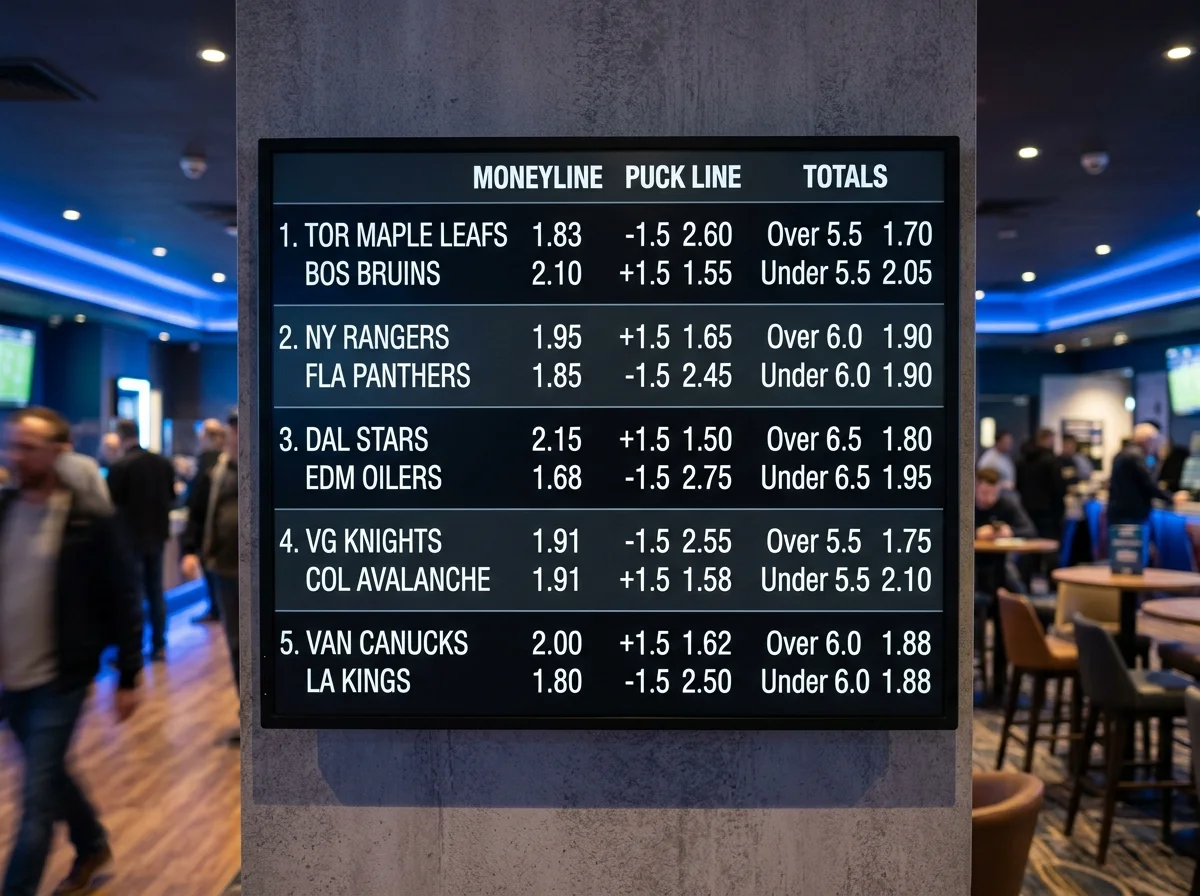
The moneyline asks one question: who wins the game, overtime and shootout included? The puck line is a fixed 1.5-goal spread laid on the favourite and given to the underdog; it converts a lopsided chalk price into something resembling an even-money proposition. Totals — over/under — predict combined goals, again with overtime and shootout counted. The three-way regulation line is a uniquely European-friendly market that splits the moneyline into home win, draw, or away win after sixty minutes only, ignoring extra time entirely.
| Market | What you predict | OT/SO counts? | Typical use |
|---|---|---|---|
| Moneyline (2-way) | Straight winner | Yes | Outright confidence picks |
| Puck line (±1.5) | Margin against spread | Yes | Converting big favourites or backing live underdogs |
| Totals (over/under) | Combined goals | Yes | Reading pace, goaltending, special teams |
| 3-way regulation | Result after 60 minutes | No | Backing tight matchups at longer odds |
The same matchup looks different depending on which line you bet. Imagine Toronto travelling to Boston on a Saturday night. The price tag tells the story:
Decimal: Boston 1.80 | Toronto 2.05
Fractional (UK default): Boston 4/5 | Toronto 21/20
American (US-style): Boston -125 | Toronto +105
Same game, same probability, three notations. Decimal multiplies stake to total return, fractional reads "profit-to-stake," American flips between favourite (minus, stake to win 100) and underdog (plus, profit on 100 staked).
I want you to walk away from this section knowing which market suits which read. Moneyline rewards conviction in the outright winner — useful, but you are paying juice on every chalky price. The puck line is the workhorse for value bettors because the underdog +1.5 has historically covered north of 60% of NHL games, which means the line price has to be juiced heavily to make the over-cover money line equivalent. Each of the big four gets its own deep treatment in the cluster pieces. This pillar is the map. Those guides are the terrain.
The mistake I see new punters make is treating the four markets as alternatives rather than tools. They are tools. The same handicap on a Vegas-Edmonton matchup might tell you to fade the moneyline, lay -1.5, take the over 6.5, and pass on the three-way entirely. Read the four prices together and the book is telling you something it does not want you to spot.
If those four markets are the tools, the notation in which they are priced is the language you read them in. UK books default to fractional. Most pros think in decimal. Let me show you why that matters.
Reading Hockey Odds the Way a UK Pro Reads Them
I will say something that annoys roughly half the punters who message me: stop reading fractional odds. Read them, sure, because Sky Bet and Bet365 default to them and you cannot escape the format on a UK platform. But think in decimal. Bet in decimal. Every UK sportsbook lets you toggle.
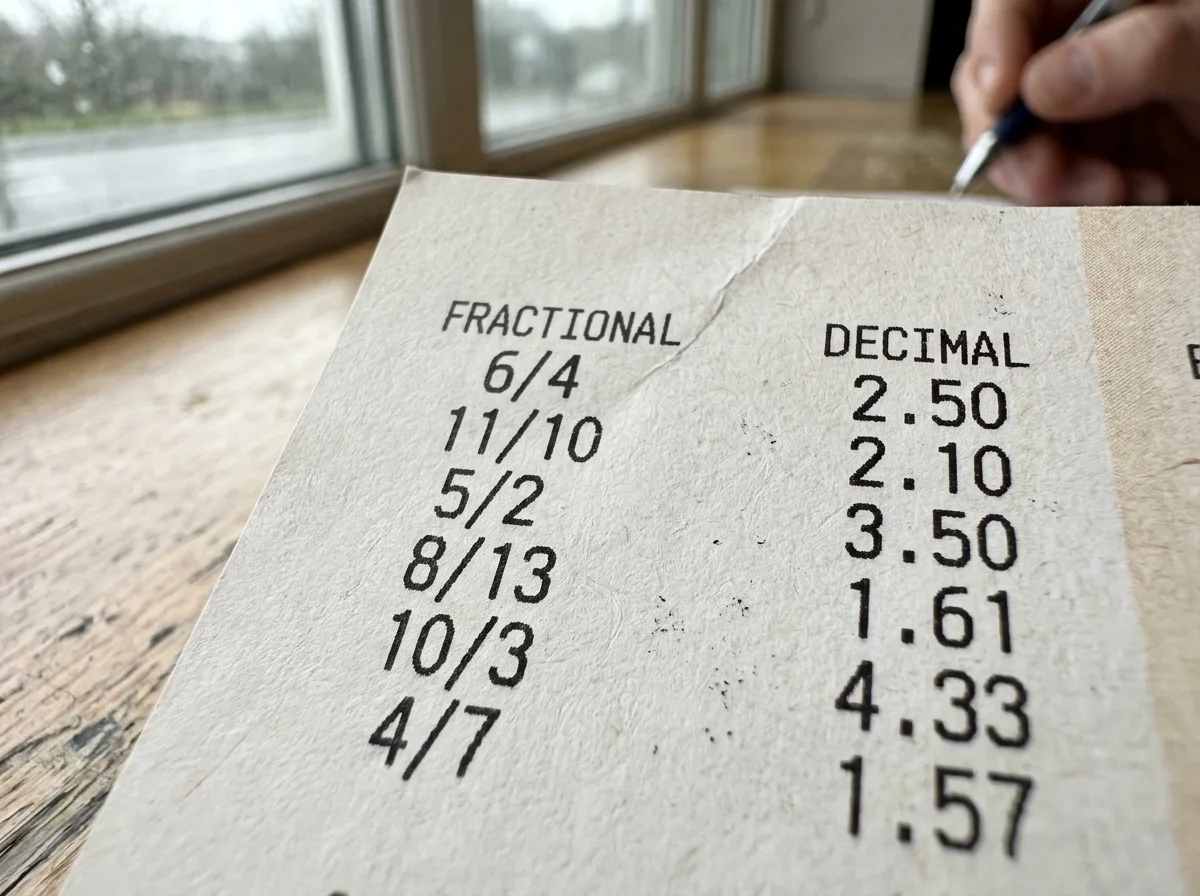
The reason is arithmetic. Fractional odds are great for "what do I win on a winning bet?" — 6/4 pays £6 profit per £4 staked. Decimal is great for "what is the implied probability I am being charged?" — 2.50 in decimal means the book thinks the outcome happens 40% of the time before vig. That is the question a value bettor actually needs answered on every bet.
Juice (vig) — the book's built-in margin. On a two-way line, true probabilities sum to 100% but priced probabilities sum to roughly 104-108%, depending on the market. That extra slice is the juice.
Devig — the act of stripping juice out of a posted line to recover the book's "fair" implied probability. Useful for comparing two books and for spotting when one is offering a soft number.
Worked example: implied probability from 6/4
6/4 fractional converts to decimal as (6 ÷ 4) + 1 = 2.50.
Implied probability = 1 ÷ 2.50 = 0.40, or 40%.
If the matching side is priced 4/6 (decimal 1.67), implied = 1 ÷ 1.67 = 60%.
40 + 60 = 100. That is a no-vig pair. In the real world you almost never see one — expect totals like 52% + 52% = 104%, with the extra 4% being the book's edge.
Once you can do that calculation in your head, the entire ice hockey shelf changes shape. A 4/5 home favourite at one book and a 5/6 at another is not a "small difference." It is the difference between 55.6% and 54.5% implied probability — and over a season of 50 bets on the same team, that 1.1% gap turns into real money. This is line shopping, and it is the most underrated edge a UK punter has. The headline rule fits on a postcard: bet at the book showing the highest decimal number for your side.
Home Ice and the Hidden Cost of a Crowded Calendar
An old coach of mine used to say the second night of a back-to-back is the closest thing hockey has to a tax. The puck drops, both benches are tired, but only one club has done it before — and the schedule, not the talent, is what writes the result. The data has caught up to him.

In 2024-25, NHL home favourites won 64.1% of their games. Home teams overall won 56.6% outright. Those numbers tell you that home ice is real and large. They also tell you exactly nothing about whether you should be betting home favourites — because the price is already in the line.
56.6%
NHL home outright win rate, 2024-25
64.1%
Home favourite win rate
63.9%
Home underdog ATS cover rate
60%
Underdog +1.5 puck line cover, 2025
Read those four numbers together. Home favourites win two thirds of the time but only cover the puck line 41.8% of the time. Home underdogs win less often outright — but cover the spread 63.9% of the time. The market knows home favourites win; what it underprices is the underdog at home staying within a goal and a half. That gap is where I live during the regular season.
The schedule magnifies all of it. In 2023-24, more rested teams went 347-277 against the spread for +13.96 units, a 2.2% ROI. Their tired opponents went 277-347 for -66.83 units, a 10.7% loss rate. Same season, home clubs playing the second leg of a back-to-back went 58-61 — a losing record despite the home ice. The home crowd cannot skate. As Jon Cooper, Tampa Bay's head coach, said during a famously condensed slate, "Everybody's tired — not just our team, all the teams." That is exactly the kind of universal complaint that gets priced incorrectly, because books cannot bake it into every line equally.
Do
- Check rest days for both clubs before reading the price.
- Treat the second night of a back-to-back as a fade candidate unless the opponent is also tired.
- Bet home underdogs at +1.5 when the schedule advantage and the price both favour them.
Don't
- Assume home ice carries the same weight in every arena.
- Lay -1.5 on a home favourite tired from a back-to-back.
- Bet a rested team blind — the price often already reflects it.
This is overview territory. I unpack the per-team home splits, the last-change advantage, and the seven NHL clubs whose schedules quietly punished bettors in 2024-25 inside the NHL season-long framework.
The Three-to-Five Per Cent Question
I lost three units on a Wednesday in November because I bet a -135 moneyline favourite at 11am, thinking I had the closing-line jump on the public. By 4pm, the team announced the backup was starting. The line moved to -110. I had paid full freight for a starter who never put his pads on. That bet taught me more than any spreadsheet.

Goaltending is the single most mispriced position in hockey because the casual market does not know who is playing until morning skate confirmations, usually two to four hours before puck drop. Sharps know this. Karry Shreeve, head of hockey at Caesars Sportsbook, put a number on it: "Like anything else, it matters, but you've got to add context to it and sometimes it matters more than others. Most of the time I'd say that a goalie, at most, is worth 3 to 5% of implied probability. So if it's -120, maybe it goes to -150, -150 to -200. But it's all in context."
Three to five per cent is small, but on a 50-bet season at flat 2% stakes, paying full price on uncertain starters costs you somewhere north of one unit per ten games. Compounded across an 82-game NHL slate plus playoffs, that is real bankroll attrition.
The wider context makes it more interesting. NHL save percentage dropped to .901 in 2024-25, a nineteen-year low. The peak was .915 in 2014-15. Goalies are not worse — shooters are better, and the league has tilted toward higher-quality chances. Andrei Vasilevskiy, Tampa Bay's goaltender, captured it from inside the crease: "I feel that players don't waste shots anymore. When I came into the league in 2014-15, it used to be 30 or 35 plus shots every game. Today, players don't waste shots. It's about quality." That structural shift means totals are systematically too low across the league until the books fully recalibrate, which they do slowly. The over has had a kinder decade than the public realises.
Confirm the starter, then bet. If you bet pre-confirmation, you are guessing on the most important single variable in the game. The closing line will tell you whether you were right; the morning line will not.
Goaltender pre-bet check
- Is the starter confirmed via morning skate or official team announcement?
- What is the starter's last seven days of save percentage, not season-to-date?
- Is this the second start in two nights for the starter?
- Has the backup started recently and is he therefore likely to play tomorrow?
- What is the opposing club's expected goals per 60 against this goalie profile?
NHL, EIHL, and the European Tournaments UK Books Actually Cover
One of the most useful realisations a UK hockey bettor can have is that the NHL is not the only league with priced markets at your sportsbook. It is the deepest market — and therefore the hardest to beat — but the Elite Ice Hockey League at home and the Champions Hockey League across the North Sea offer angles a sharp NHL desk simply does not bother with.

Start with the league you can drive to. The 2025-26 EIHL season set an attendance record of 1,321,128, averaging 3,863 per match — a fourth consecutive record. Ten clubs, 270 regular-season games. Belfast Giants took their eighth regular-season title with 84 points and a +85 goal differential. Cardiff Devils won their fourth playoff championship. Aaron Fox, Sheffield Steelers' head coach, framed the EIHL's competitive shape from inside the league: "Obviously you're never going to look past what Belfast has done. They are the benchmark right now again — they won two of the three trophies last year and before we won the treble they were right there as well winning three trophies the year before us." Three trophies a season, ten clubs, one dominant title-holder — that is a market with structural narratives a UK punter can actually track in person.
NHL
32 clubs, 82 regular-season games, deepest market liquidity, sharpest pricing. Most UK books offer full coverage including props, period markets, and three-way regulation.
EIHL
10 clubs, 270-game regular season, four trophies per season. Markets are thinner — typically moneyline, three-way, totals, occasional props. Less sharp action means more soft numbers.
Champions Hockey League
European club competition. 101 games in 2025-26, 557 goals (5.51 per match), Frölunda HC winning a fifth title. Higher-scoring than NHL on average — over bets find a friendlier environment.
IIHF events
World Championships and Olympic windows. National teams, round-robin into knockout. NHL availability swings outright pricing dramatically — track which leagues release players.
The CHL is the under-bet European product. A 5.51-goal-per-game average is meaningfully higher than the NHL's recent baseline. UK books that take CHL action often set their totals using NHL pacing as a mental anchor, which means the over has historically been a better proposition than the closing line suggests once you factor in goaltending depth on European rosters. I write the deeper EIHL analysis in the dedicated Elite League guide, which is where the per-team home records, line-shopping patterns and trophy outright maths live.
The strategic point about choosing leagues is this: the NHL is where most punters lose money to vig because the market is efficient. The EIHL is where a UK punter can build edge from local knowledge — arena travel, attendance trends, line changes that the analytics community has not yet quantified. The CHL is where pacing assumptions go to die for casual bettors who copy-paste NHL totals logic onto a faster-scoring league.
Why +EV Is the Only Thing That Compounds
I have watched a lot of punters confuse a winning week with a winning method. They are not the same. A winning week is variance. A winning method is the slow, boring accumulation of bets where your estimated true probability beats the book's implied probability. That is +EV — positive expected value — and it is the only mathematically defensible long-term posture in this game.

The professional benchmark is an edge of 2-5% per bet, sized with a fractional Kelly stake — usually quarter- or half-Kelly — against a flat 1-3% of bankroll per wager. Those numbers come from established value-betting methodology and they are not negotiable. Bet bigger than that and variance ends you. Bet smaller and the edge does not compound fast enough to matter.
The Betstamp value betting framework states it cleanly: "+EV betting is the only mathematically proven long-term winning strategy in sports betting. Every professional bettor places bets where their estimated true win probability is higher than what the sportsbook's odds imply." The implication is the part that intimidates new punters: you must have an opinion on the true probability that is independent of the line. If your model is the line, you cannot beat the line.
Worked example: +EV on an NHL puck line
You estimate the underdog covers +1.5 at home 62% of the time. The book offers 5/6 fractional (decimal 1.83), implied probability 54.6%.
EV per £1 staked = (0.62 × 0.83) − (0.38 × 1) = 0.5146 − 0.38 = +£0.135.
That is a 13.5% expected return per unit. Edge versus the book's price = 62% − 54.6% = 7.4 percentage points.
Stake using quarter-Kelly: (edge ÷ decimal odds minus 1) ÷ 4 = (0.074 ÷ 0.83) ÷ 4 ≈ 2.2% of bankroll.
Start with quarter-Kelly, not full. Full Kelly maximises growth in theory but assumes your probability estimate is exactly right. It never is. Quarter-Kelly survives the inevitable model error and still grows the bankroll meaningfully across a season.
The conceptual move I want every reader to make is from "did this bet win?" to "did this bet have a positive expectation when I placed it?" The first question is luck. The second is skill. A winning bet at -200 on a coin-flip game is a bad bet that won. A losing bet at +180 on a 40% shot is a good bet that lost. Compound enough good bets and the variance shakes out.
Why Hockey Quietly Has the Cleanest Integrity Record
If you have followed cricket spot-fixing or tennis lower-tier scandals, you might assume every sport has a comparable underbelly. Hockey, by the numbers, does not.

The International Betting Integrity Association recorded 300 suspicious betting alerts across global sports in 2025, up 29% year on year. Ice hockey appeared in none of the sixteen flagged sports. Football generated 110 alerts. Tennis produced 74. Hockey produced zero. Khalid Ali, the IBIA's chief executive, framed the broader landscape: "Our 2025 data highlights a familiar integrity risk pattern, with football and tennis continuing to account for most suspicious betting activity. At the same time, the greater scale and reach of our Global Monitoring & Alert Platform means our ability to detect, assess and support investigations across markets and sports has increased."
That platform monitors over 1.5 million matches across 80-plus sports, with more than $300 billion in annual betting turnover passing through its alert systems. The IIHF, separately, runs two monitoring layers — the IOC Integrity Betting Intelligence System and Sportradar — and runs integrity workshops at no fewer than ten IIHF championships per season.
Across every IBIA-flagged sport in 2025 — football, tennis, basketball, esports, table tennis, snooker, and a dozen others — ice hockey did not appear once. It is the largest mainstream sport in the integrity report with a clean ledger.
For a UK punter, the practical implication is permission to focus on handicapping rather than on whether the result was real. The market you are reading is a market the integrity monitors trust.
Betting Well Means Betting Less Sometimes
I am going to be direct with you, because most guides in this niche soft-pedal this section to avoid breaking the spell. The Gambling Survey for Great Britain Year 2 found 2.7% of British adults show signs of severe problem gambling on the PGSI scale, scoring 8 or higher. Among 18-24-year-olds, 5.3% sit in that top-risk band — the highest of any age group. The Commission's own estimate puts the total population of problem gamblers in Britain at around 1.4 million.

Andrew Rhodes set the regulatory expectation when releasing the GSGB Year 2 data: "This year's findings deepen our understanding of consequences from gambling and provide crucial insight into risk profiles among those who gamble most frequently. We strongly encourage operators to use this evidence to consider the risks within their own customer bases." Translation: the regulator is watching, and so should you.
The enforcement environment is also more aggressive than most punters realise. The UKGC issued more than 770 cease-and-desist notices between April 2024 and early 2025, and Google removed roughly 64,000 URLs at the Commission's request over the same window. Unlicensed sites are not a grey market — they are an actively shrunk market.
The 2.7% figure is not "other people." A serious betting practice means honestly asking yourself, on a quarterly basis, whether you sit in the bottom 80% of risk or whether the pattern is sliding the wrong way.
Do
- Set deposit limits at your operator, lower than you think you need.
- Use a separate banking instrument for betting only.
- Track your results monthly — wins and losses both.
- Take genuine breaks during international windows when your leagues are dark.
Don't
- Chase a losing day with bigger stakes.
- Bet to feel better about a non-betting problem.
- Hide betting activity from people you live with.
- Treat self-exclusion as a punishment rather than a tool.
GamStop is the national self-exclusion scheme. One sign-up locks every legal UK operator. It is the most decisive tool in the system and it costs nothing.
The Fifteen-Minute Workflow That Filters Out 80% of Bad Bets
Everything in this guide collapses into a checklist I run before every wager. It takes about fifteen minutes per game on a quiet night and closer to thirty on a heavy slate. If you cannot answer every question affirmatively, you do not bet — you wait for tomorrow's card.

The order matters. Lineup confirmation comes before market selection, because the starting goalie can swing implied probability by three to five per cent. Rest comes before home/road read, because a rested road team frequently beats a tired home club despite the apparent home edge. Line shopping comes after market selection because shopping for the wrong market only gets you a better price on a bad bet. Stake sizing comes second-to-last because the same +EV opportunity sizes differently across bankrolls. Closing line value goes last because it is a feedback mechanism for tomorrow's bets, not a deciding factor for today's.
The Slapline pre-bet workflow
- Lineup confirmed — both starting goalies announced via morning skate or official channels.
- Rest differential checked — back-to-back status, travel miles, days since last game for both clubs.
- Home/road context read against the price — does the price already include the home premium?
- Market selected — moneyline, puck line, total, or three-way regulation, based on the read.
- Line shopped — best price among UK-licensed books toggled to decimal.
- Stake sized — quarter-Kelly against estimated edge, capped at 1-3% of bankroll.
- Closing line value logged — record both the price you took and the closing price for post-game review.
The final point about closing line value is the one most amateur bettors skip and most professionals obsess over. If you consistently bet a side and the line moves toward you by closing — your team's price shortens — you are picking up CLV, which is the single best predictor of long-term profitability. Even on a losing bet, a positive CLV means you beat the market that day. Logging it teaches you which reads have substance and which were lucky guesses.
One more thing about handicapping that almost nobody outside the professional community talks about. The Covers NHL editorial team makes the case directly: "Handicapping referees is an undervalued method of discovering an edge in the odds. NHL referees and linesmen all have their unique tendencies, especially when it comes to calling penalties." Officials get assigned a few hours before puck drop. Building a referee database is a project, but at the margins it is worth a handful of units per season on penalty-minute and team-total markets.
Questions UK Punters Ask Me Most
Is ice hockey betting legal in the UK?
Yes, through any UK Gambling Commission-licensed operator. The licence number is printed in the footer of every legal site and verifiable on the Commission's public register. Offshore sites that take UK customers without a UKGC licence are not illegal for you to use, but you lose every consumer protection — dispute resolution, ring-fenced deposits, GamStop integration, the lot. There is no upside.

What is the puck line and how does it differ from the moneyline?
The moneyline is a straight winner bet, overtime and shootout included. The puck line is a fixed 1.5-goal spread: the favourite must win by two or more, the underdog wins or loses by one. The trade-off is price — the puck line converts a heavy moneyline favourite into something around even money, and converts a long-shot underdog into a price like 5/6. Different reads call for different tools. The dedicated puck line strategy guide covers the alternate lines and the maths of choosing one over the other.
How much does a starting goalie change the betting line?
Roughly three to five per cent of implied probability, according to the head of hockey at Caesars Sportsbook. A -120 moneyline becomes -150 when the starter is confirmed. That is small in absolute terms and large in cumulative terms — paying full price on uncertain starters across a full NHL season costs you meaningful units. Wait for morning-skate confirmation before pulling the trigger on a moneyline bet.
What is a 3-way market in ice hockey betting?
The three-way market splits the result into home win, draw, or away win after sixty minutes of regulation only. Overtime and shootout do not count. Because hockey games tie in regulation more often than most casual bettors think, the three-way frequently offers better prices on both sides than the 2-way moneyline. UK books push it quietly because the juice is lower on a market many punters do not understand. The moneyline guide works through when the three-way beats the 2-way.
Should I bet on home or away teams in the NHL?
Home favourites won 64.1% of games in 2024-25, but they covered the puck line only 41.8% of the time. Home underdogs covered the spread 63.9% of the time. The honest answer is that home/away is not the question — the price-adjusted question is whether the line already reflects the home advantage. Most of the time it does, which means the value lives in home underdogs against the spread, not in chasing home favourites on the moneyline.
What is the difference between betting on NHL and EIHL?
The NHL has deeper liquidity, sharper pricing, and full prop coverage at every UK book. The EIHL has thinner markets — typically moneyline, totals, three-way, occasional props — but the lines are softer because less sharp action moves them. EIHL is also a local product, which means UK punters can build edge from arena attendance, line changes and travel patterns the NHL analytics community has already priced in.
How do back-to-back games affect betting odds?
In 2023-24, rested teams went 347-277 against the spread for +13.96 units while tired teams went 277-347 for -66.83 units. Home clubs on the second leg of a back-to-back went 58-61 against the spread — a losing record despite the home crowd. The schedule is real, the market underprices it, and the second night of a back-to-back is one of the most consistent fade spots in the regular season. The totals guide covers how fatigue compresses scoring on the second night.
Turning the Playbook Into a Habit
Everything I have laid out here works only if you treat it as a repeatable discipline rather than a Saturday afternoon hobby. The numbers are honest — home underdogs covering 63.9% against the spread, save percentage at a nineteen-year low, the EIHL drawing a fourth straight attendance record, the goaltender swing at three to five per cent — but they are data, not destiny. You still have to do the work each game day.
If you take one thing from this pillar, take the workflow. Confirm the lineup, read the rest differential, choose the market that fits the read, shop the line, size the stake at a fraction of Kelly, and log the closing price. Run that for ninety days against a flat 2% stake and you will know more about your own edge than most punters learn in five years.
Articles
Created by the "Ice Hockey Betting Tips" editorial team.
