
Deposit Limits and Responsible Gambling for Hockey Bettors
 Available in US

Setting Effective Deposit Thresholds on UK Betting Sites
A friend of mine, a smart bloke with a good job and no obvious risk factors, lost three months’ salary in a six-week stretch on NHL in-play during the 2024 playoffs. He told nobody at the time. I found out after the fact when he asked, casually, about whether GAMSTOP could be reversed. He had self-excluded the previous week, when the bank balance forced the question. The exclusion held. He recovered. He still bets — sensibly, with limits — and is one of the most disciplined punters I know now. But the six weeks before the exclusion should not have happened, and almost every safeguard that would have caught it earlier was sitting in his account settings unused.
This article is about the safeguards. Not the platitudes. The specific tools UK-licensed operators are legally required to offer, and how to actually use them.
Why hockey bettors in particular need the tools
NHL in-play is one of the more dangerous markets for problem behaviour, and the structural reasons are worth naming. The games run late for UK punters — typical puck-drop is between midnight and 3am UK time. Decisions made at 2am, when judgement is poorest, are decisions about the largest concentration of bets in a single session. The in-play product cycles faster than the cognitive recovery window after a loss, which means chase behaviour can compound across a single game without any of the natural breaks football or cricket provide.

Numbers help locate the problem. The UK Gambling Commission’s 2024 statistics show a measurable rise in late-night in-play behaviour across all sports during the post-pandemic period, with sports betting now accounting for a substantial share of overall industry turnover. The point is not that betting late at night is inherently a problem — it is that the structural conditions of late-night NHL betting interact poorly with normal human decision fatigue.
The tools below are calibrated to those specific risks.
Deposit limits set the ceiling before you need it
Every UKGC-licensed operator must offer deposit limits — daily, weekly and monthly caps on how much you can move into the account. The limit is set in the responsible-gambling section of account settings and applies immediately when reduced. Increases are subject to a cooling-off period, typically twenty-four hours, which means you cannot lift the limit in the heat of a losing session.

The right time to set a deposit limit is when you open the account. Not when you are losing. Not when you are winning. At the moment of opening, when the question is entirely abstract and you are thinking about your overall finances rather than the specific game on tonight. Set the limit at the amount you would be willing to lose in a typical month, then divide by four to get a weekly limit, then by seven for daily. The limit should bite occasionally — that is the point — but should not bite so often that you spend the whole month at the cap.
The hardest version of this conversation is the one with yourself about what a “willing to lose” number actually is. The honest test: if this amount disappeared next week, would my rent, my bills, my food shopping, my partner’s evening plans all proceed exactly as they would have done otherwise? If the answer is no, the limit is too high. Adjust it down.
Reality checks and session limits break the cycle
UK operators are required to offer “reality checks” — periodic pop-ups during a session that show your time spent gambling and your net win/loss. The default frequency is usually thirty or sixty minutes. The customer can configure it tighter.
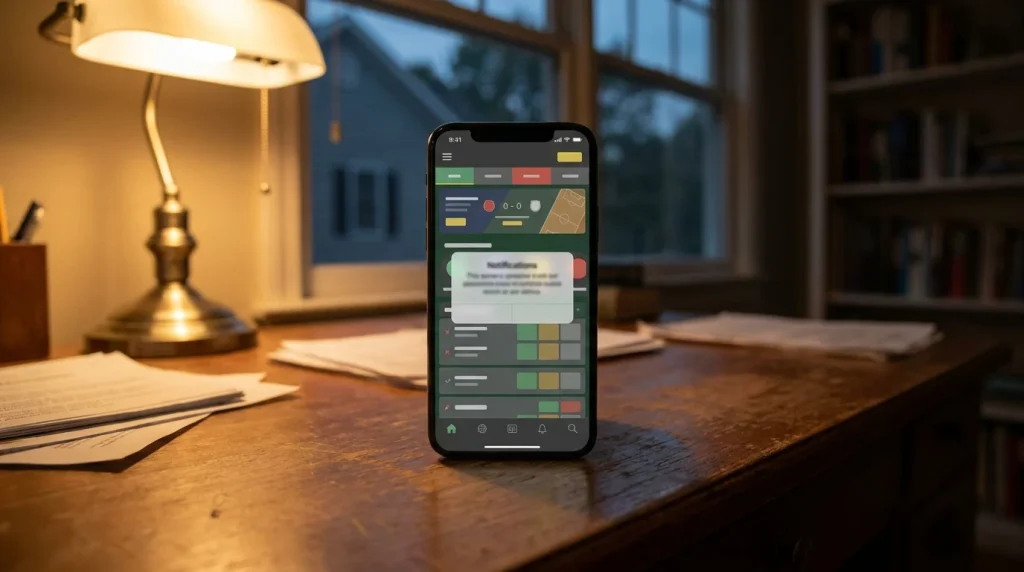
The mistake most bettors make is leaving the default. Sixty minutes is too long for an in-play hockey session, where the action and the emotional swings move much faster. I run mine at fifteen minutes for in-play and thirty for pre-game wagering. The pop-up itself is a small interruption. The interruption is the point — it pulls you out of the flow state where one bet leads to another without conscious thought, and forces a one-second check on whether the session is still what you intended.
Session limits work similarly. Set a maximum length for a single login — two hours, three hours, whatever your honest pattern needs — and the operator will log you out at the cap. The log-out is annoying. The annoyance is, again, the point.
Self-exclusion and GAMSTOP
The escalation path beyond deposit and session limits is self-exclusion. Every UKGC-licensed operator must offer self-exclusion at the operator level — you choose a period (six months, one year, five years) and the account is locked for the duration, with no possibility of early reversal.

The cross-operator equivalent is GAMSTOP. Registering with GAMSTOP excludes you from every UKGC-licensed operator simultaneously for the chosen period. The exclusion is honoured by every UK-licensed book including the major brands like Bet365, William Hill, Paddy Power, Sky Bet and Betfair. Once active, it cannot be cancelled before the chosen period ends. There is no exception, no appeal, no early release.
The deliberate friction of “no early reversal” is what makes the tool work. The brain that wants to bet at 3am has no recourse. The brain that wakes up at noon, having self-excluded the previous evening, finds the decision permanent for the chosen period. That is the design.
If you have ever found yourself, at the end of a losing night, looking up whether a self-exclusion can be reversed, you are the person GAMSTOP exists for. Sign up. The mechanism is straightforward, free, and takes about fifteen minutes. The cost of doing it is zero if it turns out you did not need it. The cost of not doing it, in the specific moment when you do, is incalculable.
The markers your operator is required to monitor
UKGC licensing requires operators to monitor for “markers of harm” — behavioural patterns that suggest a customer may be developing or experiencing problem gambling. The list of markers is detailed in the Commission’s guidance and includes: sudden increases in deposit frequency, multiple deposits in a short period, late-night-only patterns, chasing behaviour after losses, cancellation of withdrawals to return to play, and rapid escalation of stake size.

When markers fire, operators are required to intervene. The intervention typically starts with a friendly message — usually a pop-up or an in-app banner asking whether you would like to take a break or review your spending — and escalates to direct contact from the operator’s customer-protection team if the pattern continues. The intervention is not a marketing technique. It is a regulatory obligation.
The intervention is welcome when it lands at the right moment. It is, in my experience, a slightly intrusive irritation when it lands at the wrong moment — the night I cashed a long Cup futures ticket and was promptly invited to consider whether I needed a break. The friction is the cost. The cost is worth paying because the same system, on a different night, catches the friend whose six weeks should have been six days.
What support looks like outside the account
GamCare runs the National Gambling Helpline — 0808 8020 133 — which is free, confidential and available twenty-four hours a day. The helpline can talk through immediate concerns, refer to face-to-face support, and connect callers to NHS gambling treatment services where appropriate. The NHS itself now operates specialist gambling clinics in several UK regions, with referrals available via GP or self-referral.

The reason to mention the helpline is not that everyone reading this needs it. Most readers do not. The reason is that the moment you need it is the moment you least want to look it up — saving the number now, when the question is abstract, removes one barrier between the moment of crisis and the call.
The other useful service is GamBan, a software tool that blocks access to gambling websites and apps from your phone, tablet and computer. It costs a small subscription and is genuinely effective at adding the friction needed to break a late-night pattern. Pair it with GAMSTOP for redundancy — GAMSTOP blocks at the operator level, GamBan blocks at the device level.
Setting up the toolkit on day one
The configuration that actually protects you, in the order I would apply it: open the account, complete KYC, set a deposit limit at one-quarter of your “willing to lose” monthly figure, enable reality checks at fifteen-minute intervals, set a session limit at two hours, save the GamCare helpline number to your phone contacts, and consider GamBan if late-night patterns are a known weakness for you.

The whole configuration takes about ten minutes. Done at signup, none of it requires you to be in a difficult moment. Done after a bad session, every individual step is harder to enact and easier to rationalise away.
The friend whose three months disappeared has all of these in place now. He still bets, still loses sometimes, still wins sometimes, still enjoys NHL playoff hockey as much as anyone. The difference is that the architecture around the betting now has the brakes the architecture was always supposed to have. Hockey betting can be a sustainable hobby for adults with disposable income. The tools above are how you make sure it stays one.
For the financial side of that sustainability — sizing bets, tracking the bankroll, knowing when to stop — the hockey betting bankroll management guide is the companion piece.
What is GAMSTOP and how does it work for UK hockey bettors?
GAMSTOP is the UK"s national self-exclusion scheme. Registering with GAMSTOP excludes you from every UKGC-licensed operator simultaneously for a chosen period — six months, one year, or five years. Once active, the exclusion cannot be reversed before the period ends. The service is free and takes about fifteen minutes to set up at gamstop.co.uk.
How do I set a deposit limit at a UK betting site?
Every UKGC-licensed operator has a responsible-gambling section in account settings where you can set daily, weekly and monthly deposit caps. The limit applies immediately when reduced. Increases are subject to a cooling-off period of at least twenty-four hours, meaning you cannot lift the cap in the middle of a losing session.
Where can I get help if NHL betting is becoming a problem?
GamCare runs the National Gambling Helpline on 0808 8020 133 — free, confidential and available twenty-four hours a day. The helpline connects callers to face-to-face support and NHS gambling treatment services where appropriate. GamBan is a software tool that blocks gambling sites at the device level and pairs well with GAMSTOP.
Articles
Written by the editors at Ice Hockey Betting Tips.
