
Player Volume and NHL Shots-on-Goal Prop Betting
 Available in US
Targeting Role Players in SOG Prop Markets
The most consistent prop edge I have found in five years of betting NHL is shots-on-goal over on third-line wingers in high-pace matchups. Not the star wingers. Not the headline-grabbing names. The role players who skate fifteen minutes a night, log a couple of power-play shifts on the second unit, and shoot the puck whenever it comes to their stick. Their lines are coarse — 1.5, 2.5, occasionally 3.5 — and the public bets the under because the names are unfamiliar. That asymmetry has paid me consistently across about three thousand tracked bets.
“Everybody’s tired — not just our team, all the teams,” Jon Cooper once said about a condensed schedule. The line that gets missed is what tiredness does to shot patterns. Tired role players shoot more, not less, because they fall back on simpler reads — see puck, shoot puck — rather than working a high-quality chance.
The market types
UK books carry three main shots-on-goal prop variants. Over/under on a player’s individual shots — the standard market. Player to record 4-plus or 5-plus shots — the alternate line variant. And same-game parlays involving multiple players’ shot totals, which I will not discuss here because the correlation maths makes them a losing bet for the average punter.
The standard over/under is where the value lives. Most players have lines somewhere between 1.5 and 3.5, with juice that varies from -110 to -130 depending on the book and the matchup. The alternate-line variant — “to record four or more shots” — is interesting on volume shooters who occasionally produce six and seven shot nights, but the juice on plus-money alternate lines often eats the edge before it appears.
Saves over/under on goaltenders is a related but distinct market. The same volume logic applies: a starter facing a high-pace opponent at home has a saves line that often runs under the matchup’s true expectation, because the book is anchored to a season average that does not reflect tonight’s expected shot total.
Role and ice time
Ice time is the single best predictor of shot volume. A player skating 18 minutes a night against a 14-minute night generates roughly 30 % more shots on average, all else equal. The book is supposed to adjust for this — and mostly does — but coaches change ice-time deployments more frequently than the prop models can track.
Three ice-time signals matter most for next-game shot props. First, the previous game’s ice time. A player who logged 21 minutes last game because of a top-line injury is likely to log similar minutes tonight if the injury persists. Second, the upcoming opponent’s expected matchup. Coaches stack their offensive lines against weaker opposing defensive pairs, and a heavily favourable matchup can spike a single player’s ice time by three to four minutes. Third, special-teams unit assignments, particularly PP-1 deployment.
The bettor’s job is to read these signals before the line moves. By the time the book has adjusted the prop price, the edge is gone. The morning skate and confirmed line-up release between 4 and 6pm UK time is when the work happens.
Opponent shot suppression
The opposing team’s shot-suppression number is the other half of the equation. Some teams allow 28 shots per game; others allow 34. That six-shot difference translates into individual player props swinging by roughly half a shot each across the top-six forwards. Books price this matchup adjustment, but not as completely as they price the offensive side, and certain low-suppression teams travel with persistently inflated opposition shot totals.
A few teams sit at the extremes worth memorising. The strong shot-suppressors run conservative neutral-zone systems and force opposing forwards into perimeter chances rather than slot opportunities. Their props go under more reliably than the season average suggests, because they bend opposing shot quality downward as well as quantity.
The weak shot-suppressors are the opposite — they let opposing forwards walk into the slot and rack up high-quality chances. Their visiting players’ shot props skew over consistently, especially the top-six forwards who get matched against the weak defensive pairing.
Pace and SOG
Pace is the simplest input people overlook. A 5-on-5 pace metric of 60 shot attempts per 60 minutes per side produces a very different game from one running at 50. Two high-pace teams meeting on the same night will produce shot totals 15 to 20 % above the league average, and every individual player on both sides becomes a stronger over candidate.
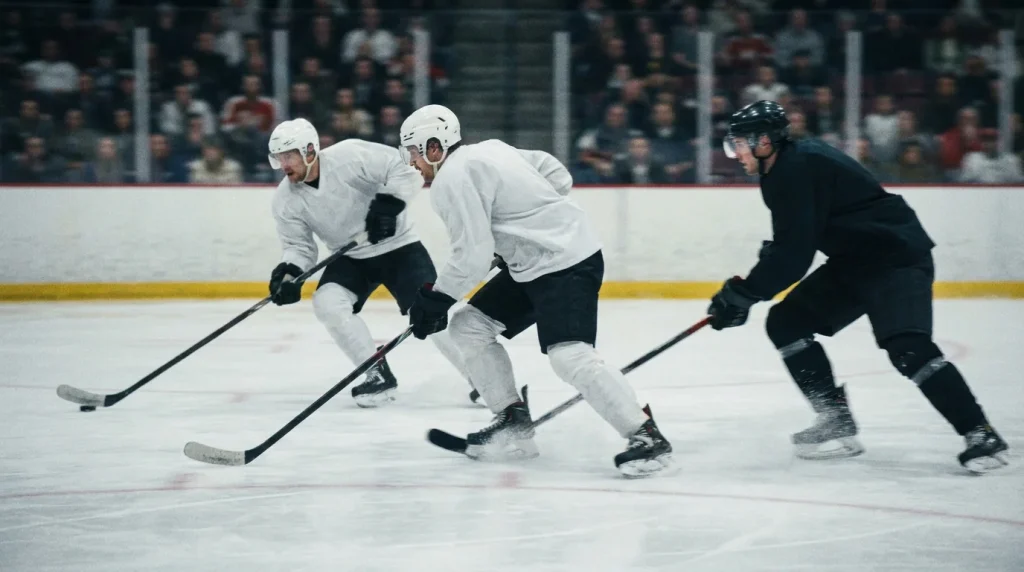
The mistake is treating pace as a single number. Some teams play high-pace at home and low-pace on the road. Some pick up pace in the third period when they trail. The matchup-specific pace projection — not the season average — is what should drive the prop call.
UK punters often miss this because the popular pace stats are reported as season aggregates rather than situational splits. A bit of digging into home-versus-road splits often produces meaningful prop edges, especially in cross-conference matchups where the playing styles diverge most sharply.
Putting it together for a typical week
A standard NHL betting week, for me, has six to ten shots-on-goal prop plays. Most are unders on stars whose lines feel inflated by reputation. A handful are overs on role players in favourable matchups. One or two are on goaltender saves markets, typically overs on backups facing high-pace opposition.

NHL save percentage league-wide hit .901 in 2024-25, a nineteen-season low. That decline has a knock-on effect on shot props too — pace is up, shots per game are up, and every prop line should arguably be priced a half-shot higher than two seasons ago. Books have caught up partially but not completely. The lag is the edge.
Stakes are small. Half a per cent to one per cent of bankroll per prop, no more. The variance on shot props is enormous because a single referee call or an unlucky deflection past the goalie can wipe out a four-shot night. Plan for it and stake accordingly.
For the broader fatigue framework that makes role-player overs more reliable, the back-to-back NHL betting piece is a sensible pair — tired teams shoot more from worse positions, and the role-player shot lines are where that pattern shows up most cleanly.
Why do star players miss SOG overs more often than role players?
Books price the stars" shot totals sharply because the public bets them. The lines drift to or above their true expectation, leaving very little edge. Role players are priced from season averages that often lag their actual current usage, which is why the role-player over has been more profitable for me across a long sample.
Does playing a B2B affect SOG output?
Yes, in a counter-intuitive direction. Tired players tend to shoot more rather than less, because they fall back on simpler reads — shoot when in doubt — rather than working high-quality chances. Total team shots can rise on the back end of a back-to-back even as goal totals fall. The shot over on role players in fatigue spots is a recurring angle worth tracking.
Articles
Written by the editors at Ice Hockey Betting Tips.
