
Line Shifts and Starting Goalie Impact on NHL Odds
 Available in US
Reacting to NHL Goalie Confirmations and Line Moves
For years I would place my NHL bets around 4pm UK time, finish dinner, watch the evening news, then check my phone to find the price I had hit had moved two or three cents the wrong way. Same teams, same matchup, same totals — but a different goalie wearing the number-one jersey on the warm-up sheet. That five-minute window between morning skate and confirmed starter is where small bettors hand value back to the book without realising it.
Goaltending is the position with the most concentrated impact on a single game’s outcome anywhere in major league sport. Not because the goalie is a superstar, but because they touch every shot and the position is binary — they are either on the ice or they are not. Confirming the starter is the most underrated free information in NHL betting.
When the morning skate actually confirms a starter
The morning skate is a light optional session held roughly six hours before puck drop. The goalie who takes the bulk of the reps and stays on the ice longest is, with very high reliability, that night’s starter. Beat reporters then confirm it on social media within twenty to forty minutes of the session ending. UK punters who place bets between 4 and 6pm are betting before this confirmation, which means they are paying a guess premium.

Two complications matter. First, some coaches — particularly old-school veterans — deliberately misdirect about goalie assignments to deny the opposition pre-game preparation. The morning skate signal is weaker for these clubs. Second, back-to-back games almost always feature a backup on the second night, and the line you see at 11am will already partially reflect that expectation.
What this means in practice: if you cannot wait until starter confirmation, do not bet moneylines below -150 on tight matchups where the goalie matters most. Wait, or stake smaller. The price you take at 4pm is paying for information you could have for free at 5pm.
The mathematics of the line shift
“Most of the time I’d say that a goalie, at most, is worth 3 to 5 % of implied probability,” Karry Shreeve, who heads hockey for Caesars Sportsbook, told ESPN. “So if it’s -120, maybe it goes to -150, -150 to -200. But it’s all in context. It’s all team-specific, it’s situation-specific.” That number — three to five per cent — is the working figure I use every day.

Translated to UK fractional odds, a starting goalie change typically shifts a moneyline from around 5/6 to 1/2, or from 6/4 to even money, depending on the direction. The size of the shift depends on the gap between the two goalies. Backing up a starter with a similar-skilled backup might cost you one to two per cent; backing up a Vezina-quality starter with an AHL call-up can move the line eight to ten per cent.
The largest line shifts I have personally seen this season have been on totals rather than moneylines. A backup goalie with a noticeably worse save percentage flips a 5.5 total to a 6, and a confident over becomes a coin flip. The totals market is where goalie information has the biggest leverage, because the totals are priced around season-long averages that assume the starter.
Reading the backup signal
The interesting question is not when the starter is confirmed, but when the backup is. A coach who announces the backup the day before is telling you the matchup matters less than the rest. A coach who announces the backup at the morning skate is sometimes telling you the starter is injured or being protected, which carries different implications for the next three or four games.

What I track when a backup is confirmed: the goalie’s recent save percentage, his career number against the specific opponent, and whether the team’s defensive structure tightens up when the backup plays. Some coaches deploy a noticeably more conservative scheme when their backup is in — fewer offensive-zone deployments, more dump-and-chase, lower shot totals against. That structural change is a totals story as much as a moneyline story.
The backup’s own form matters less than people assume. NHL backups are streaky by job description — they play eight games in two weeks, then sit for ten days, then play three more. Recent results are a small sample. League-average backup performance is the more useful baseline than the goalie’s own last five starts.
Save percentage context
NHL save percentage league-wide dropped to .901 in 2024-25, the lowest mark across a nineteen-season span. The peak was .915 in 2014-15, so we are looking at fourteen points of save-percentage compression in a decade. That has a direct implication for totals pricing — every team’s expected goals against has crept up, every total line should have shifted half a goal higher, and not every book has fully caught up.

Andrei Vasilevskiy of Tampa Bay offered a player’s view on why. “I feel that players don’t waste shots anymore. When I came into the league in 2014-15, it used to be 30 or 35 plus shots every game. It was almost every night you felt good about your performance because you were in the game all the time. Today, players don’t waste shots. It’s about quality.” Quality shots beat quantity shots, save percentages compress, totals creep up, and the bettor’s job is to be ahead of where the book has set the number.
The interaction with goalie confirmation is the part that matters. A backup goalie in 2014-15 was facing 35 medium-quality shots a night and giving up two goals. The same backup in 2025-26 is facing 28 high-danger shots and giving up three. The expected goals against jumps more sharply when a backup plays now than it did a decade ago — which means the line shift on a goalie change should arguably be larger than the three-to-five per cent benchmark, even if the books have not fully repriced it.
How I structure goalie-related bets
My discipline: I do not bet pre-confirmation more than one per cent of my bankroll on any single side. I save my normal stake for after the morning skate, which for UK punters lands between 4 and 6pm depending on the venue. I check both starters before clicking. If the confirmed starter is a surprise — backup playing when the public expected the number one, or vice versa — I usually wait another hour for the market to settle before betting.
The mistake to avoid is overweighting goalie news. Hockey is a team sport played by twenty skaters and one goalie, and the twenty skaters drive most of the outcome. A great goalie behind a bad team is still betting against a bad team. The goalie is a modifier, not a switch. Three to five per cent is meaningful but bounded.
The other mistake is treating every goalie change as a betting opportunity. Most goalie news is already in the price by the time you see it. The value lies in the matchups where the news is fresh, the price has not fully moved, and the underlying matchup makes the goalie’s contribution unusually important — typically tight games where one or two goals decide everything.
Putting it into a routine
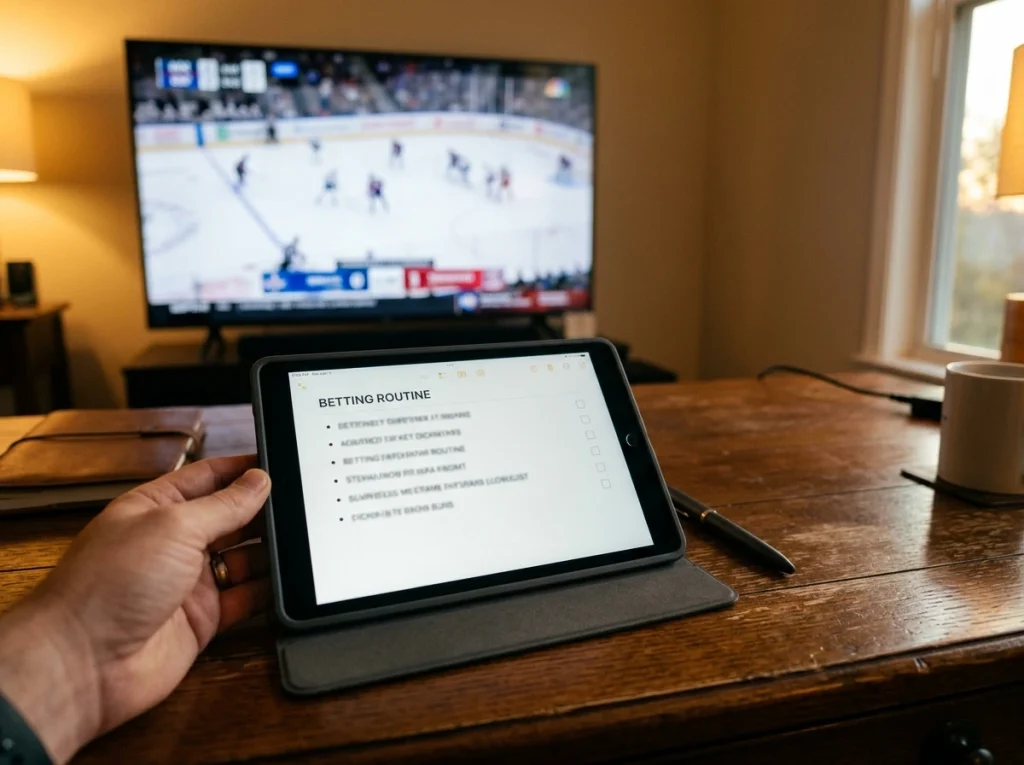
The UK punter’s day, structured around morning skate releases, looks something like this. Late afternoon: pre-set your watchlist of moneylines and totals you are interested in. Early evening: refresh for confirmed starters, ideally between 5 and 6pm UK. Commit your stake only after both are confirmed. If a starter is in doubt, either reduce stake or pass. The discipline costs nothing and saves four or five units a season at modest volume.

If you are working from a fatigue model rather than a goalie model, the framework still applies — fatigue and goalie status compound. A backup behind a tired team is one of the worst stacks of factors you can bet against, and the price rarely reflects that compounding fully. Pair this with the moneyline betting approach and the two-factor lens becomes the spine of a sensible NHL workflow.
When are NHL starting goalies officially confirmed?
Beat reporters typically confirm starters between twenty and forty minutes after the morning skate ends, which for most NHL clubs means roughly six hours before puck drop. For UK punters that lands between 4 and 6pm UK time depending on the team"s venue. Some coaches deliberately delay confirmation, particularly for big games, but the morning-skate signal is reliable for most teams most nights.
How much should I bet before the starter is confirmed?
My rule is no more than one per cent of bankroll on any pre-confirmation bet. The goalie shift of three to five per cent implied probability is large enough to wipe out a normal stake"s edge, so the cost of being wrong about the starter is asymmetric. Wait for confirmation when you can, reduce stake when you cannot.
Articles
Written by the editors at Ice Hockey Betting Tips.
