
International Tournament Odds and IIHF Betting Markets
 Available in US
Finding Value in IIHF Knockout Stage Pricing
By the time the IIHF Worlds tip off in mid-May, the NHL playoffs have eaten everyone’s attention and the tournament shows up almost as a side dish. That is precisely why I love betting it. Markets are thinner, public money is distracted, and the operators who do price the games often lean heavily on simulation outputs rather than scout work. Some of the softest hockey lines I see all year sit in the IIHF group stage.
The 2025 edition was a good case study. The United States ran the table on the way to gold, finishing with seven regulation wins, two overtime wins, no overtime losses and one regulation loss, scoring 46 goals and conceding 18 across ten games. The pre-tournament outright on the Americans was not short — call it a board fixture rather than a confident favourite — and the path to the trophy looked obvious only in hindsight.
How the tournament is built
Sixteen nations split into two groups of eight. Each team plays the other seven in its group, top four advance to quarter-finals, and the bracket runs single-elimination from there. Two big consequences for bettors. First, the round-robin format means a single loss almost never knocks you out — top sides are incentivised to manage minutes, rest goalies and experiment in the back half of the group stage. Second, the quarter-finals are cross-pollinated, so the bracket structure can leave one half of the draw markedly tougher than the other.

UK books typically price every group game on a three-way line, with totals built around the 5.5 or 6.5 mark depending on the matchup. Outrights, group winners and “to reach the medal round” markets are standard. Player props are thin and inconsistent — a few books push them late in the tournament, most never do.
Where group-stage value actually lives
The most consistent edge I have found is fading top-tier nations on the back end of the group stage. Canada, USA, Sweden and Finland routinely send their depth through the closing games once qualification is secured, sometimes resting their starting goaltender, sometimes shuffling lines to test combinations for the knockout round. Books are slow to adjust the totals down, even slower to shift the three-way line, and the resulting prices on draws or modest underdog wins can be genuinely soft.
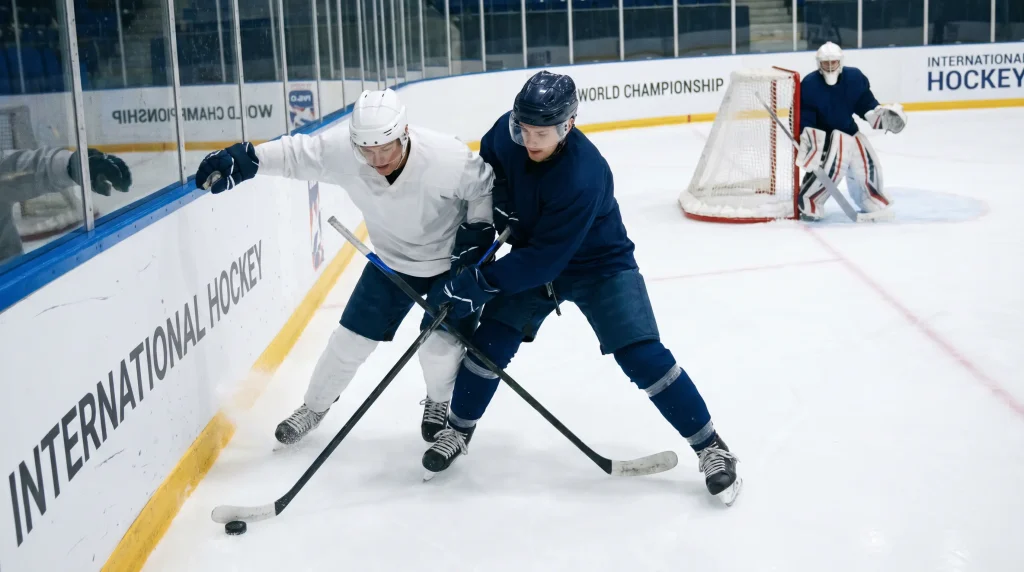
The mistake is doing this blindly. Some “depth” lineups still feature seven NHLers and a starting goalie who simply needed a different number on his back. The work is to check the morning line-up release, not the team list from three days ago. If you cannot get the morning information from the UK, you should not be betting the back half of these group games at all.
The other angle worth knowing: opening games tend to over-price the marquee team. Tournament openers attract casual money on famous shirts. Underdogs covering on the first night is one of the older patterns in the IIHF book.
Knockout pricing is a different animal
Once the bracket starts, the prices tighten quickly and the structural edges disappear. Quarter-finals are usually two-way moneyline plus a three-way regulation market, with the books loading vig because variance over a single game is enormous. I rarely bet quarter-finals straight up. Instead I look at the three-way regulation line, because IIHF rules push games to ten-minute three-on-three overtime followed by a shootout, and the favourites in this tournament have a noticeably weaker shootout record than their regulation form suggests.

Semi-finals concentrate the public’s attention and the books respond by widening the markets — more props appear, more alternate lines surface, and the totals start to drift two or three goals wide of the regular-season equivalent. That drift is your indicator. When a UK book is willing to take alternate goal lines from 4.5 to 9.5 on a single game, they are protecting against variance, and they are doing it with extra juice.
The outright winner market
Outrights here behave differently from Stanley Cup futures. The tournament is two weeks long, the roster is set the moment the pre-tournament camp ends, and the players are not playing for contracts. That makes the outright market more about goaltending and coaching style than about depth or chemistry. Goaltending in particular swings tournaments — a hot streak from a number-one goalie can paper over a mid-tier roster, and a cold goalie can sink a stacked one.

My rule for IIHF outrights: do not bet anything longer than +1500 unless you have a specific informational reason. The mid-board between +400 and +1200 is where the value sits, because public money piles onto the two or three pre-tournament favourites and leaves the second tier fairly priced. Czechia, Sweden and Finland in that range have given me more cashed outrights than the favourites have.
I usually take two tickets — one mid-board, one slightly longer — and let them ride into the medal round.
Integrity monitoring matters more here than people think
One reason I bet IIHF events without anxiety is the integrity infrastructure behind them. The IIHF runs surveillance through two systems in parallel: the IOC Integrity Betting Intelligence System, known as IBIS, and Sportradar’s monitoring platform. Integrity workshops are held at a minimum of ten IIHF championships every season, with players and staff briefed on match-fixing approaches.

For UK bettors this is more than reassurance. It is part of why ice hockey has historically been absent from the suspicious-activity reports that flag football and tennis as the high-risk sports. When a market is clean, you are competing only against the book’s vig and the public’s biases — both beatable problems. When a market is dirty, you are competing against information you cannot see, which is not a game you can win.
“Our 2025 data highlights a familiar integrity risk pattern, with football and tennis continuing to account for most suspicious betting activity,” noted Khalid Ali of the International Betting Integrity Association in the body’s 2025 report. Hockey did not appear on the list. That absence is a feature, not an oversight.
Practical advice for UK punters on tournament days
Morning games in the UK start around lunchtime and the evening games run into UK prime time, which means the IIHF is the rare hockey property that fits comfortably into a UK punter’s day. That is also why public money is heavier on this tournament than on a midweek NHL slate — and why the books charge slightly more juice on the headline matchups.

I split my staking across the tournament rather than loading the first two days. The early games are read-the-room games; the back half of the group stage is where the prices loosen and the information edge actually compounds. I also avoid building accumulators across IIHF games. Correlation between top-side wins is real, totals correlate even more strongly, and the resulting prices are almost always wrong against the bettor.
For the wider European context — and how the Champions Hockey League competes for the same attention pool earlier in the season — the Champions Hockey League betting guide covers the club side of European hockey wagering.
How does the IIHF round-robin format affect underdog value?
Round-robin removes the elimination pressure of the first week, which means top sides routinely rest starters and experiment in the closing group games. Books are slow to adjust, and underdogs covering against rested-down favourites is one of the most reliable angles in the tournament.
Are Olympic odds the same as IIHF Worlds odds?
No. Olympic hockey has NHL participation only in selected cycles, and rosters are typically deeper when the NHL releases its players. IIHF Worlds runs in May, which means many top NHL players are still in the Stanley Cup playoffs and unavailable, reshaping the outright market significantly.
Why do NHL players" availability swing IIHF outright odds?
A nation that loses early in the NHL playoffs can suddenly add three or four impact players to its IIHF roster mid-tournament. Books adjust outright prices in real time as call-ups are confirmed, which means waiting to bet outrights until late group stage can give you a sharper read on actual roster strength.
Articles
Prepared by the Ice Hockey Betting Tips editorial staff.
