
Specific Match Events and Ice Hockey Prop Bets
 Available in US
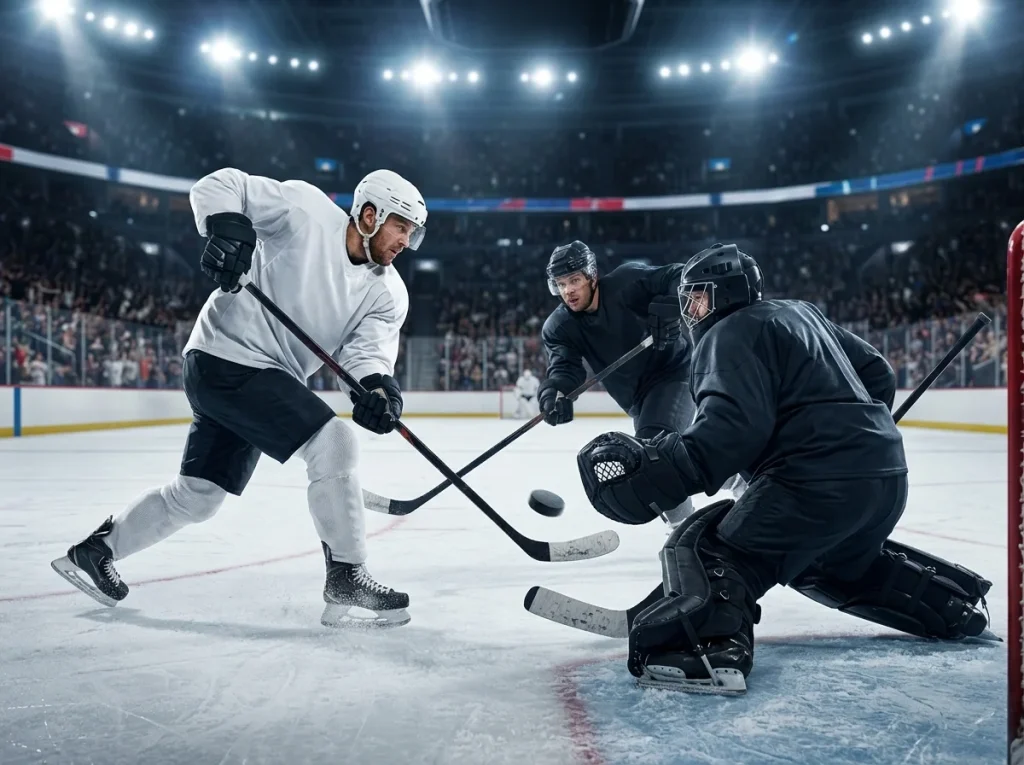
Identifying Value in Ice Hockey Player Props
If you asked me to liquidate my bankroll and choose one market to bet on for the rest of my career, I would not pick moneylines. I would pick props. The pricing on player props at UK books is materially softer than on game lines because the books cannot afford to dedicate the same modelling depth to twelve players per game as they do to the matchup itself. That is not a brag about my edge — it is a structural feature of the market, and any UK punter willing to do the line-up work can take advantage of it.
Props are also where the goalie news, line-combination news and ice-time news all matter immediately. A casual bettor reading the morning paper has the same information advantage on a moneyline as on a prop. But the moneyline is sharper because more money flows through it. The props are stale by design.
The categories worth your attention
Props fall into four broad buckets. Player goal markets — anytime scorer, first scorer, last scorer, two-or-more goals. Shots-on-goal markets — over/under on a player’s individual shots. Saves markets — over/under on a goaltender’s total saves. Combo markets — points, assists, and various same-game parlays that combine the above.
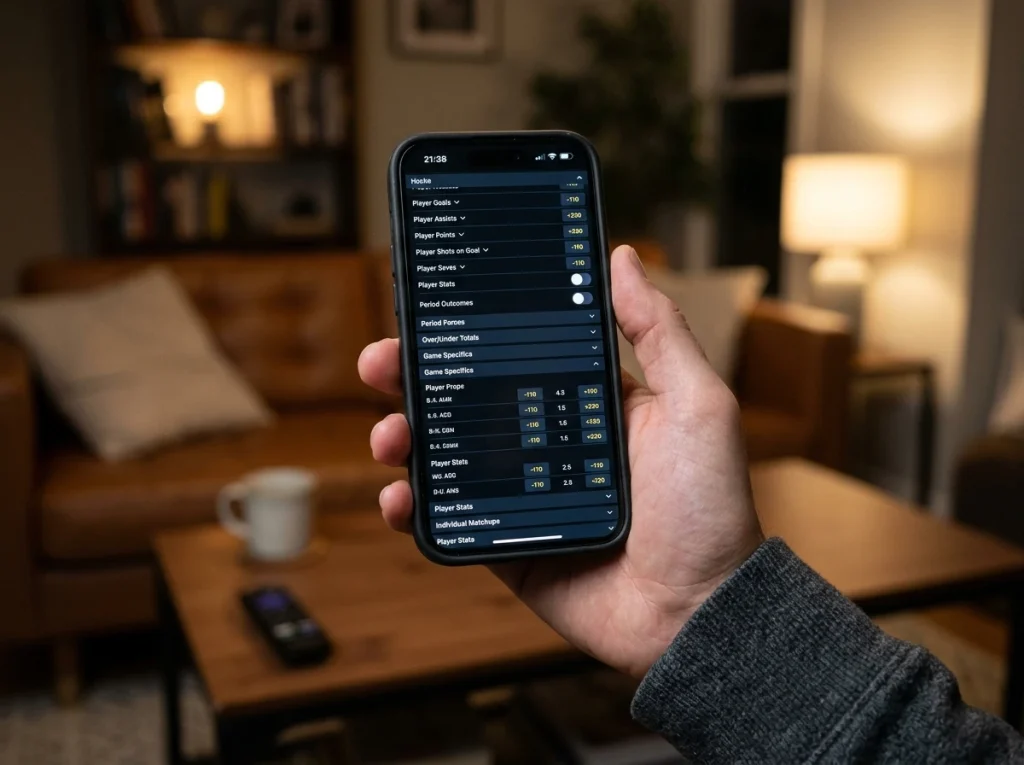
The four categories carry wildly different juice levels and edge profiles. Anytime scorer is the most heavily bet and most efficient. Shots-on-goal is the softest and most exploitable. Saves are bookended by goalie selection — easy when the starter is confirmed, dangerous when you guessed wrong. Same-game parlays exist because they print money for the books; do not bet them without understanding the correlation maths.
If you are new to props, start with shots-on-goal. The lines are coarser, the public bets the wrong side because they overvalue star power, and the role-player edge is genuine and persistent.
Matchup research that actually moves the needle
The mistake new prop bettors make is starting from a player’s season average and adjusting from there. The right starting point is the line-up — specifically, the line and special-teams unit that player is currently on. A second-line winger averaging 2.4 shots per game means nothing if he has been moved to the third line in the past three games. His average will catch up to his role within a fortnight; the prop line, set by the book using a longer baseline, may not.

The four inputs I check before any prop bet. Recent line combinations, ideally from the past four games. Power-play unit deployment, because PP time is the single biggest driver of shot and goal volume. Opponent’s defensive matchup — which pair the player’s line is likely to draw. Pace metrics for both teams, because high-pace games inflate every prop and low-pace games depress them.
“I feel that players don’t waste shots anymore. When I came into the league in 2014-15, it used to be 30 or 35 plus shots every game,” Andrei Vasilevskiy of Tampa Bay said in a piece on the save-percentage decline. That same quality-over-quantity shift means individual shot props are increasingly about who is on the ice when the shots happen, not who can chuck pucks from the boards. That changes how you research these markets.
Usage and line shopping
Usage is the prop bettor’s term for ice time and role. A player averaging 18 minutes a night with 3 minutes of PP time generates fundamentally different prop opportunities than a player averaging 14 minutes with no PP time. Usage is also more volatile than most stat lines — a coach can shift it dramatically from one game to the next based on matchup, score and injury news. The books often price props off the season average rather than the current usage; the bettor’s job is to spot the divergence.

The other essential discipline is line shopping. UK books price props inconsistently because they each use slightly different models. A 2.5 shots-on-goal line at -110 on Bet365 may sit at 3.5 at -120 on Sky Bet. The fair-value calculation depends on which line you can find. If you only ever bet at one book, you are leaving real money on the table — typically two to three percentage points of edge per prop, which over a season is the difference between a winning and a losing book.
I check at least three UK operators before placing any prop bet. The marginal time cost is five minutes; the marginal price improvement is consistent enough that it pays for the time many times over.
Top-five home scorer angles
One of the more reliable team-specific prop angles is anytime scorer markets on the top home performers. Los Angeles, in 2024-25, ran a .829 home points percentage on the back of a 1.94 home goals-against average — meaning they won close, low-scoring games where the goal distribution concentrated on a small number of players. Backing the top-line winger on a strong home team in a low-total environment is often a more profitable scorer angle than backing a flashier player on a road team.

The countercase is the high-event home matchup, where Winnipeg or Edmonton put up five-plus goals at home and any of three or four players could score. In those games, the anytime scorer market is generously priced on second-tier names — the third-line centre who plays 90 seconds of power-play time, the fourth-line winger riding a hot streak. Those are the names the public ignores and the books occasionally underprice.
Live prop windows
Live props are the wild west of NHL betting. Most UK books offer in-play shots and saves markets, with the lines updating between whistles. The largest edges I find live are in the intermissions, especially when a player has had unusual usage in the previous period — a third-liner taking PP-1 reps because the regular forward is injured, or a star winger logging single-digit shifts because of disciplinary action.

The intermission line for that player’s shots or scoring prop often lags the actual usage shift by a full period. By the time the second period starts, the book has updated, but if you bet during the first intermission with fifteen seconds of attention to who is on the bench getting yelled at, you can occasionally find lines that are flatly wrong.
The risk live is the opposite — chasing usage that won’t continue. A player who got two minutes of unusual PP time in the first period may revert to his normal role in the second. Read the situation, not the spreadsheet.
Books with the deepest prop menus
The UK prop landscape is uneven. The major operators carry the marquee props on most NHL games but vary widely on depth. Bet365 carries the largest menu for top-five marquee fixtures. Sky Bet and Paddy Power push props on UK-friendly afternoon games more than evening US-coast matchups. The smaller operators frequently skip props entirely, especially on lower-tier matchups.
What matters more than menu depth is line quality. A deep menu of badly-priced props is worse than a small menu of fair ones. Track which books move first when news hits — the slow-moving books are the ones you want to bet at, the fast-moving ones are the ones you want to compare against.
One last word. Props feel like the most “hockey” of the markets — you are betting on individual players and the action you watch on the ice. That emotional engagement is precisely why bettors over-commit and lose. Stake props at the same percentage as moneylines, never more. The edge is real but the variance is high, especially on the goalscorer side. For the specific shots-on-goal deep dive that complements this overview, the NHL anytime goalscorer bets piece picks up where this one leaves off.
Which UK books offer the most NHL props?
Bet365 typically posts the deepest menu for marquee NHL fixtures — anytime scorer, shots, saves, and combos. Sky Bet and Paddy Power are competitive on UK-friendly afternoon games. Smaller UK operators frequently skip props on lower-tier matchups. Compare across at least three books per prop bet.
Why are EIHL props thinner than NHL props?
The EIHL market handles a fraction of NHL volume, so books cannot justify the modelling investment for prop-level pricing on Elite League fixtures. Some props appear on playoff weekends or marquee league games, but the depth is far below NHL. Stick to game lines for most EIHL fixtures.
Should beginners avoid same-game parlays of props?
Yes. Same-game prop parlays look attractive because the payouts compound, but the legs are heavily correlated and the books load extra juice precisely because of that correlation. Beginners almost always underestimate how much edge they are giving up. Bet single legs until you have a year of tracked results.
Articles
Prepared by the Ice Hockey Betting Tips editorial staff.
